
INDUSTRY CONFIDENCE EDGES UP, BUT UNCERTAINTY PERSISTS
The opening session of the ATN Forum 2026 has delivered a cautiously optimistic snapshot of the adventure travel sector, with Roy Barker of SPIKE Insight presenting findings from the ATN Survey, which canvassed 150 travel industry leaders in February 2026.
The headline figure is a seven-point rise in the ATN Confidence Index. Barker’s data shows 36% of respondents are more confident about their business prospects than a year ago, 35% feel the same, and 29% are less confident — a modest but meaningful shift in sentiment.
Growth is being driven primarily by group tours, though Barker noted a degree of contradiction in the data, with some leaders simultaneously expressing less confidence in that same segment. Europe continues to dominate consumer demand, led by Spain, Italy, Portugal and France, while Morocco, Japan, Costa Rica and Nepal are performing strongly. For emerging destinations, Central Asia, Saudi Arabia, Algeria and the Nordic countries are all registering increased interest from operators.
Activity trends are pointing clearly towards cycling — particularly e-bikes — alongside the established pillars of hiking, multi-activity and wildlife experiences.
DIGITAL MARKETING UNDER PRESSURE
One of the starker findings from Barker’s survey concerns pay-per-click advertising, which appears to be losing its grip on the market. Some 38% of respondents said PPC is less effective than last year, 42% said it is performing at the same level, and only 30% reported improved results — a picture Barker described as a hardening market.
Price has emerged as the dominant factor in booking decisions, cited by 58% of respondents, ahead of destination choice and itinerary. The top three concerns among operators remain security, economic conditions and shifts in consumer behaviour. Notably, AI and technology ranked relatively low as a worry — though attitudes towards AI disruption are hardening, with 45% of respondents saying they are moderately or very concerned, up from 40% last year.
AI adoption, meanwhile, remains in its early stages. Only 12% of respondents said they have effectively integrated AI into their business — up significantly from 3% last year — while 34% are currently “in the process” of adopting it.
Barker offered a characteristically direct assessment of AI’s limitations in the sector: “You would find it very difficult to replicate a group tour with ChatGPT. You can’t manage them and introduce them, so it can’t impinge on the delivery of group tours.”
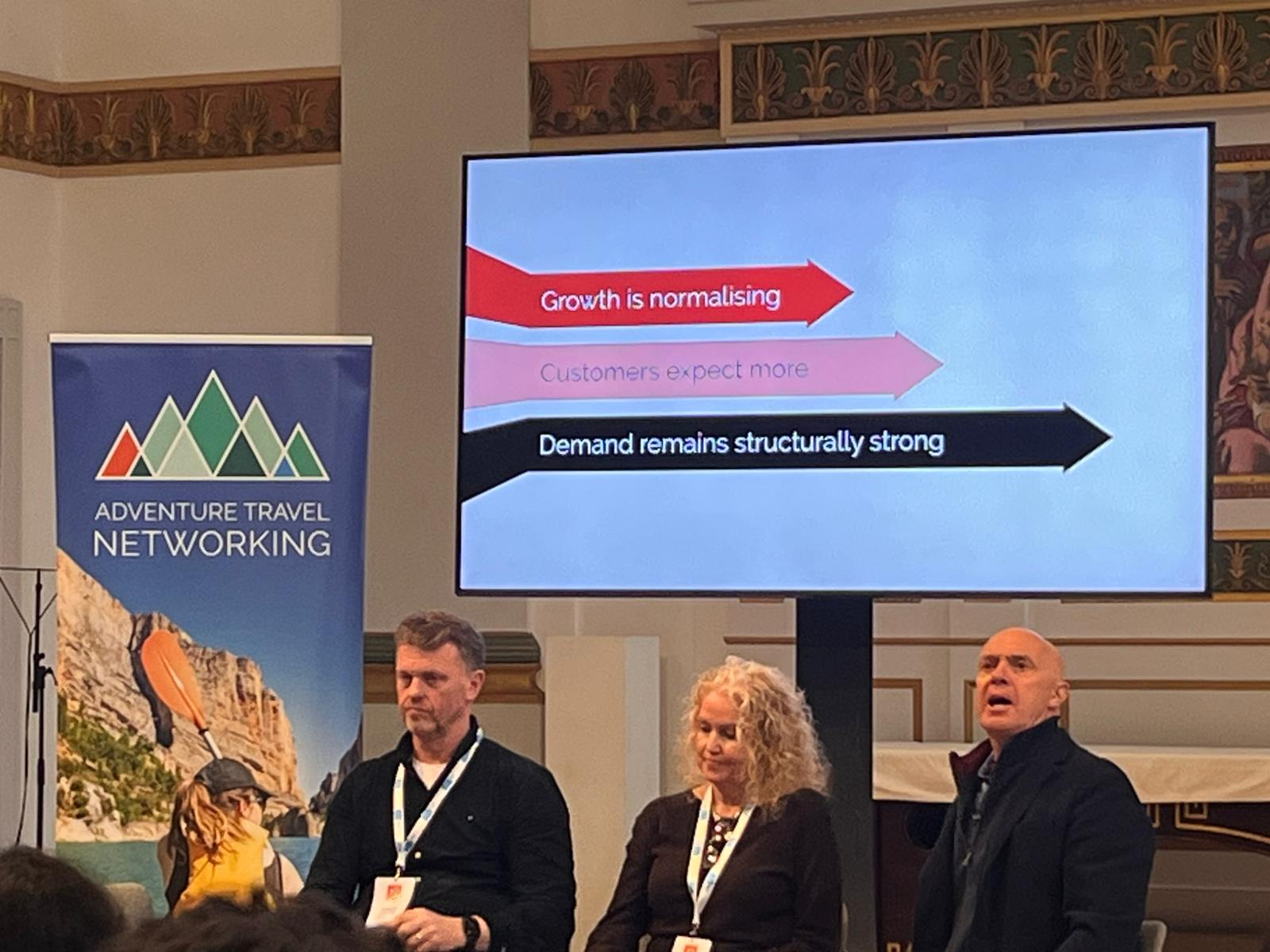
On the underlying strength of the market, he added: “Demand is structurally strong: the market is older, more affluent, with willingness to spend and spending power. Travel is a necessity, not a luxury, and they will trade off other things to travel.”
WILD FRONTIERS: ADAPTING TO THE AI SHIFT IN MARKETING
Claire Tobin of Wild Frontiers took to the floor to address the practical realities of operating in an AI-influenced marketing environment. Her candid assessment of the impact on organic traffic drew considerable attention from delegates.
“We are losing some of the blog traffic, which affects visitor traffic coming in,” Tobin said. “To overcome this we have to facilitate the AI, with the Q&A they’re asking. We now have better conversion lower down the funnel.”
Tobin said the past year has been a significant learning curve. “We’ve learned a great deal over the past year from a marketing perspective. We use it to increase efficiency within the business. It’s useful for reporting and some of the administrative tasks. We haven’t mastered AI but it is about embracing it.”
On the question of AI-generated itineraries and the suggestion that tailor-made travel may be in decline, Tobin acknowledged the trend but said it has not dented group tour demand. “One of the statistics suggests that tailor-made is declining. We are seeing people can use AI to create their own itineraries. This doesn’t affect group tours.”
Wild Frontiers has recorded a notable rise in solo travellers, a trend Tobin linked to the growing prevalence of bucket-list thinking. “Solo travel is on the rise. But what we are seeing is more people are looking at bucket-list activities. That might be different from their partner’s, so we have a lot of solo travellers. Many more solos within group tours. They have a list of things they want to achieve by a certain time.”
To cater to this appetite for the extraordinary, Wild Frontiers has developed a range of pioneer tours — including a departure to Iraq — for travellers seeking something beyond the conventional. “They want exciting adventures,” Tobin said.
She struck a notably resilient note on geopolitics, a factor that might be expected to weigh heavily on a company operating across 61 destinations. “Most of our destinations have geopolitical challenges. That hasn’t changed. We plotted the geopolitical events of the past two years but trade was fairly consistent, with small bumps along the way. Things are occurring all the time, but with 61 destinations we are very agile.”
On overtourism and pricing, Tobin offered a clear strategic direction: “To avoid overtourism we need to do green season and not promote peak season. Prices aren’t going down but people are more demanding. It helps communities and customers.”
KE ADVENTURE TRAVEL: FAST-MOVING LANDSCAPE AND THE US PULLBACK
Ashley Toft, managing director of KE Adventure Travel, provided what may have been the session’s most candid account of operating in an era of profound and fast-moving change — from AI disruption to the geopolitical fallout reshaping booking patterns.
“Things are moving so fast; I don’t know how it is going to affect how people travel,” Toft said, setting the tone for a frank assessment of the industry’s current moment.
On AI’s impact on the advertising sector, his remarks were blunt: “The advertising sector is decimated: 10% of staff are gone this year, because AI can deliver what people delivered. It doesn’t deliver it well, but they don’t seem to care about that. People are not controlling the delivery. But there may come a point where AI gets more control over what we could deliver.”
KE is deploying AI primarily in customer profiling and audience targeting. “For us where we are using it most is on the customer profiling side, creating audiences for marketing. It influences how we structure information on the website.”
Toft described a volatile start to the year before a recovery in bookings: “There is huge uncertainty. Confidence changes by the day. January was really tough. We didn’t match the previous year. But it has come back.”
As a company built predominantly around walking and trekking, KE has also witnessed the e-bike revolution reshaping its cycling offer. “Cycling is gaining popularity. The e-bikes allow couples to go together, where one does more cycling and the other is less certain about how strenuous it will be. That’s in both group tours and self-guided cycling trips.”
Perhaps the most striking data point from Toft was a complete collapse in bookings to the United States — a remarkable development for one of the world’s leading leisure destinations. “We’ve seen a downturn in bookings to the US — not a single booking right now. It’s because of the general negative view of what’s going on in the US.”
By contrast, Greenland has delivered a record-breaking year for the company: “We’ve had our best year for Greenland ever! We couldn’t believe it. All PR is good PR.” Toft cautioned, however, that the surge may not be sustained: “This year isn’t looking as strong; those who wanted to get ahead of the game have gone.”