
Live coverage | February 2026
Prayer is not a strategy: trust and optimism in the age of AI
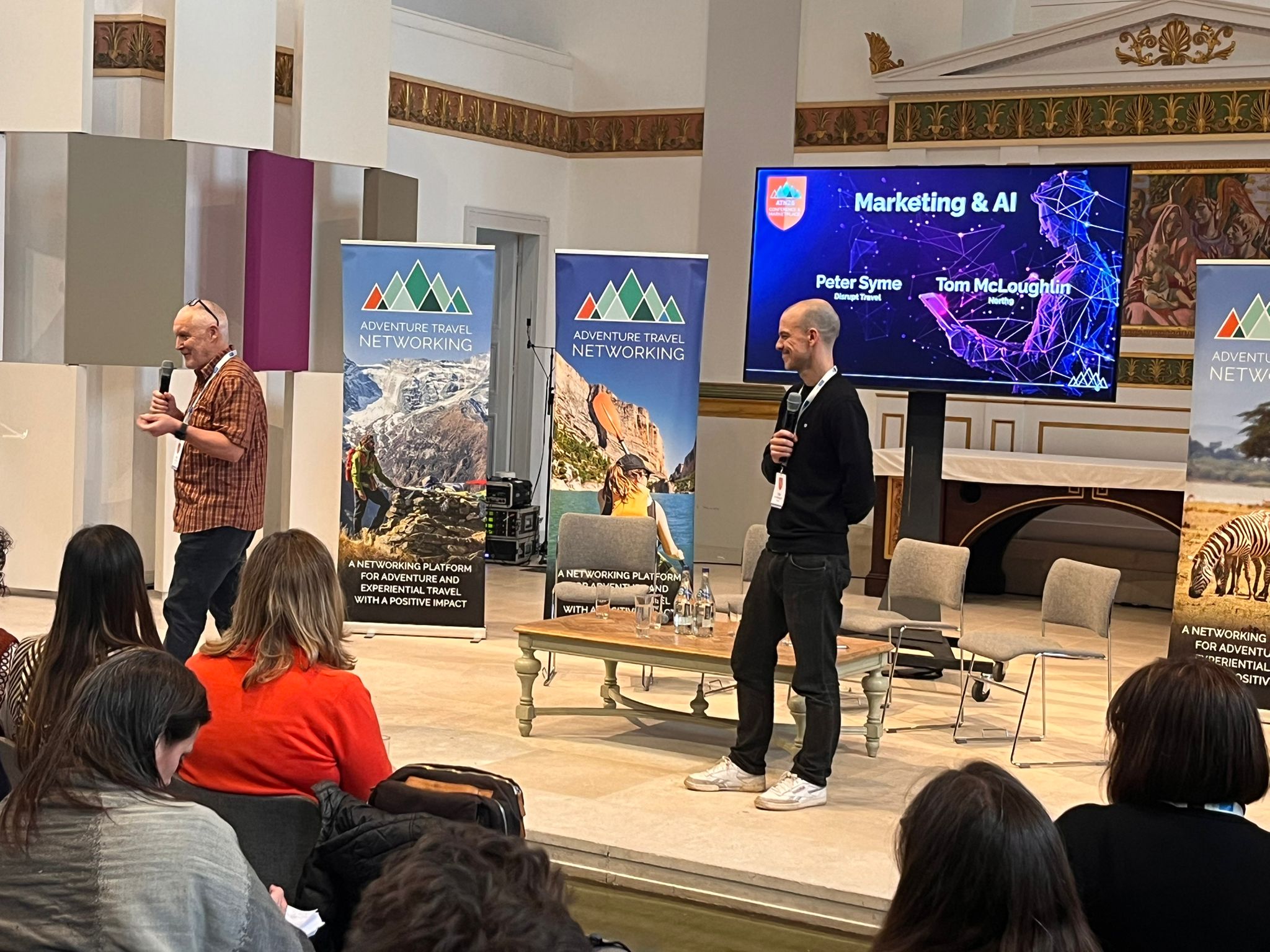
The final session of the day at ATN 2026 turned to the question every operator in the room is grappling with: what does AI actually mean for how you market your business, and what do you do about it right now? Two speakers with contrasting but complementary perspectives — Peter Syme of Disrupt Travel and Tom McLoughlin of Northg — delivered a session that mixed big-picture thinking with hard, practical advice.
Peter Syme, Disrupt Travel: the gap between AI capability and adoption is growing
Syme opened with a line that landed in the room: “Prayer is not a strategy: it is what you do when everything has gone pear-shaped. You don’t start with it.”
His central argument was one of cautious but genuine optimism. Despite the turbulence of the current moment, he urged delegates to resist the pull of anxiety. “The world is feeling pretty miserable. But we should be optimistic. You are all living in the best version of the world. Medical advances due to AI will improve healthcare. We are living in the best possible time ever. We don’t need to worry, because overall it is the best time of life. But the transition to the time of abundance will be chaotic, even if it ends up ok. We need to be optimistic and we have a future of responsibility to those who come after.”
On the pace of AI development, Syme was unequivocal. The models are advancing far faster than the industry — or any industry — can absorb. “The AI models are growing vertical. The adoption rate is not going vertical. The gap between what models can do and usage is growing. We won’t be able to close that gap. If we banned AI development today, it would still take us 20 years to catch up. But don’t worry about that.”
The implications for discovery and search are already profound and largely unnoticed by consumers, he argued. “Ten to 30% of discovery has already been displaced by AI. Most readers don’t even realise that Google is using AI. And it is probably doubling every year. The model you built your business on in the past has been reversed.”
In this environment, Syme argued that two things are increasing in value simultaneously: direct audience relationships and human trust. “Your email list has gone up in value dramatically because you control it. If you show up in AI search the conversion rate is higher, but it won’t compensate for your dropped positioning in search results. Companies are investing in in-person events so they can connect directly and create a community for referrals. You may need to double down on old school things.”
He closed with a thought on what will ultimately differentiate operators in an AI-saturated market. “Trust is probably your core advantage if you go into this crazy world. Technology will increase; trust and verification will differentiate you from others.”
Tom McLoughlin, Northg: know your audience and make your email list a living community
McLoughlin struck a deliberately practical note, acknowledging the pace of change but urging delegates not to be paralysed by it. “We want you to come away with practical things to do. What tone was today will be different in two weeks’ time. There are a few things we can do.”
His starting point was audience clarity. “You have to know who your audience is, what they’re doing, and where they are hanging out.” He recommended using AI tools — specifically Gemini and ChatGPT — to build detailed customer personas from existing testimonials and data. “Feed data into Gemini and ChatGPT to create your tourist persona. It’ll find information from testimonials. Do it as a first step to start building your strategy out.”
On AI’s role in the wider customer journey, McLoughlin urged a measured approach. “AI is a piece of everything else: discovery, research, planning. Don’t throw the baby out with the bath water. Try to understand their journey and get visible in those places. Don’t stop everything to learn one platform, but keep your eyes open and feed it into your strategies.”
His most emphatic point concerned email, which he positioned not as a legacy channel but as the most valuable owned asset an operator has. “Email should be a living, breathing community-building tool for storytelling and inspiration. However people find you, all roads should lead to your email list. You can provide background and share videos to build connections. When customers like and trust you, they will book.”
Q&A: from AI adoption to effective integration
The session closed with a Q&A that drew out some of the most actionable advice of the afternoon.
Brian from Ventura Travel asked where the biggest AI opportunities lie beyond marketing and customer acquisition. McLoughlin pointed to automation: “If you have developer capacity you can build automation streams. You can do a lot with Gemini and ChatGPT, training them to be a thought leader. You can do it at a simple level, or do a lot with a small team.” Syme added that back-office operations are already being transformed across the industry. “So many companies are now using AI for back-office operations. It’s becoming easier to do that. Identify the pain points you are looking to address, but mark those you want kept away from AI. Everything else can be automated.”
Mark Wright of The Adventure Connection asked how companies can move from AI adoption to effective integration. McLoughlin’s answer was characteristically grounded: “It’s easy to drown in all the information. Play with it for small, specific scenarios. If you try to do everything you won’t get anywhere.” Syme focused on the human side of the challenge. “You have to give your people confidence to win them over. Give them a simple task and time to figure it out. If they can solve a problem with it, they will take it up and use it every day.”