
Live coverage | February 2026
The disconnect at the heart of responsible tourism
Richard Hammond opened the session with a statistic that framed everything that followed: less than 1% of Jamaica’s coastline is accessible to its own residents. The gap between tourism’s promises and its reality on the ground is not a niche concern — it is structural, and the industry has lacked the tools to confront it honestly. Until now, perhaps.
Hammond also noted a significant shift in consumer expectations, citing Booking.com data suggesting 60% of its users would like AI to highlight listings with demonstrable positive community impact. The demand for proof is no longer a fringe position.
Much Better Adventures: building the tool the industry has always needed
Alex Narracott of Much Better Adventures delivered what may prove one of the most consequential presentations of the forum, laying out both the scale of the problem and a working solution his company has built to address it.
He was direct about the industry’s failure to move beyond rhetoric. “We are not talking anywhere near enough about economic impact and economic impact modelling. Tourism promises to create jobs, protect cultural heritage, and fund conservation. We all know this story. But there is a huge disconnect.”
The numbers behind that disconnect are stark: between 50% and 80% of tourism spending leaks away from the destinations being visited, raising a fundamental question about whether much of what the industry calls responsible travel is extraction dressed up as benefit.
Adventure tourism has long claimed to be different, but Narracott argued that claim has rested on anecdote rather than evidence. “Adventure tourism says it is better, but can we prove it? We have anecdotes but not evidence. There have been scattered studies and initiatives, including G Adventures’ Ripple Score, but no one has gone deeper. There’s a lack of hard, empirical evidence. But demand for proof is growing. Consumers are more sceptical.”
The barriers to proving impact have been practical as much as political. “Data collection is expensive and it is complicated to model. Impact-driven businesses are often poorly equipped to tell their stories.”
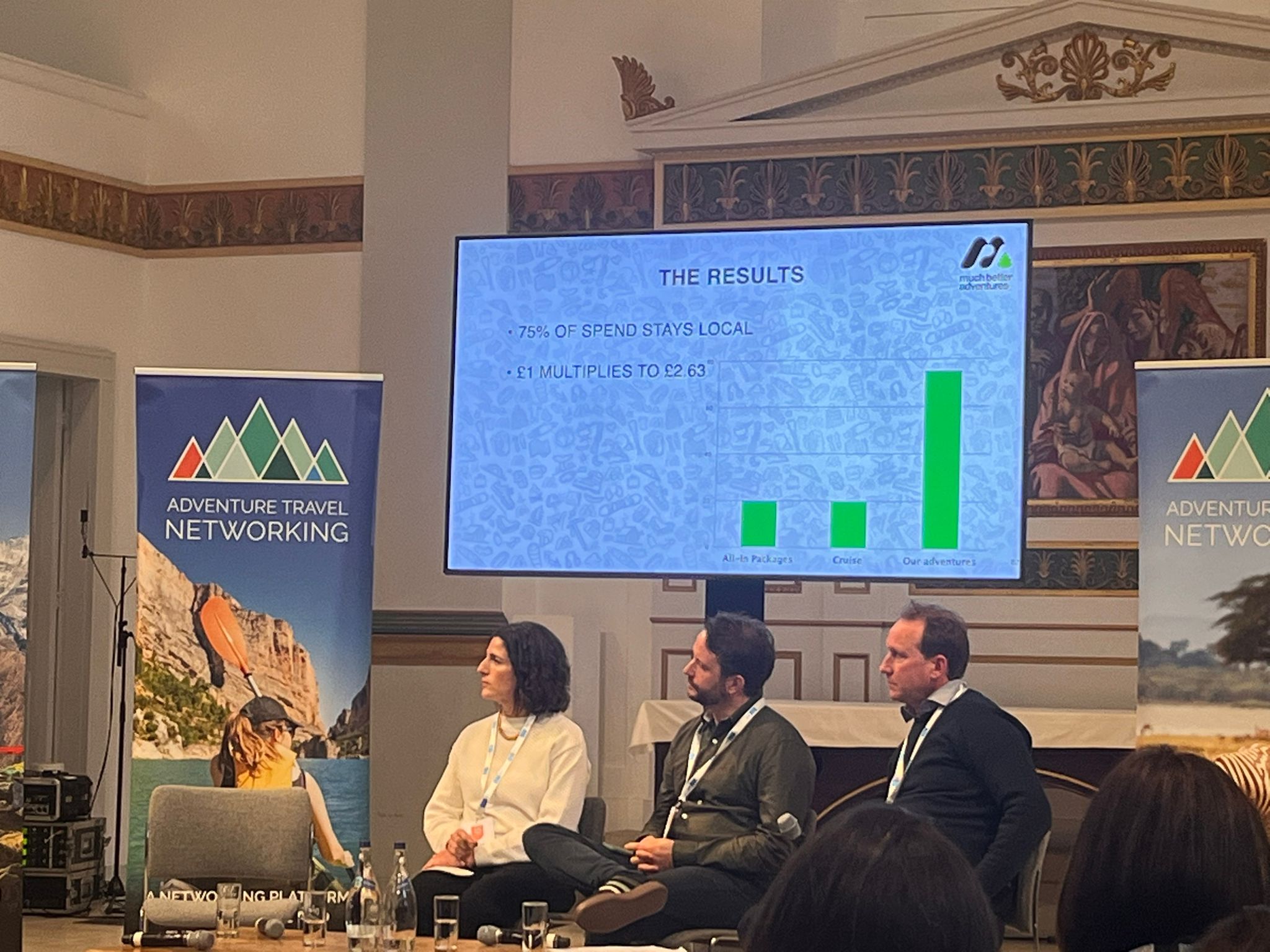
Much Better Adventures has responded by building an AI-powered tool that converts text itineraries into structured data, allocates spend across categories and calculates what actually stays in the local economy — including the multiplier effect of that spend. The results are visualised through a live dashboard for every tour, viewable by day, sector and product.
The headline findings are striking. Across Much Better Adventures’ portfolio, 75% of spending stays in the local economy — and with the multiplier effect, every £1 of local spend generates £2.63 of economic activity. In Nepal across nine itineraries, 78% of spend stays local. In Tanzania the figure is 68%, with the business directly supporting 67 jobs in a single year.
Narracott contrasted this sharply with the economics of package holidays and cruises, which contribute significantly less to local economies — a structural difference the industry can now demonstrate with data rather than assertion.
The ambition extends well beyond Much Better Adventures itself. “We now need academic and supplier validation. The model improves continuously. The more operators use it, the better. It can impact trip design and inform bold, evidence-based storytelling. We can do better, faster reporting. And we can influence policy.”
He called for the creation of an economic impact label to sit alongside carbon labelling, arguing it would drive rapid industry-wide improvement and allow adventure tourism to demonstrate to the broader travel sector what genuinely positive impact looks like. “Adventure is a massive part of the solution to some big societal problems which we face.”
Planeterra: the resource reality of deep impact assessment
Thomas Armitt of Planeterra offered an important counterweight to the optimism around new tools, stressing that meaningful impact data remains extraordinarily difficult and expensive to gather at depth.
“Accurate data collection is resource intensive. This can’t be understated. Our annual impact survey takes four teams the best part of two months. This takes trust and relationship building. We really look at trying to find deeper impacts; not everything is good. What are the ripple effects on communities? This is what Planeterra is interested in finding out.”
Armitt was nonetheless enthusiastic about the potential of Much Better Adventures’ model to lower the barrier to entry for operators who want to make impact assessment a core part of their business rather than an occasional exercise. Planeterra’s own data is linked automatically to its CRM, enabling partners to understand impact in real time and incorporate it into their own reporting.
He was emphatic that the scope of this work must not remain confined to the adventure sector. “It is essential that this is applied to all parts of the industry, not just adventure travel. The information needs to be accessible to consumers.”
His framing of the underlying challenge was precise: “Travel has impact. There is a negative impact. What we have to prove is that our trips also have a positive impact, balancing out the negative. It’s an impact return on investment for emissions, for example.”
Exodus Adventure Travels: the qualitative dimension
Kasia Morgan of Exodus Adventure Travels described a methodology that is grappling with both the quantitative and qualitative dimensions of impact — and the considerable difficulty of knowing which data points matter most.
“We’ve been scratching our heads on this for a long time,” she said. Exodus currently extracts data manually on trip lengths, nights in local accommodation, meals in local restaurants and similar metrics, but Morgan acknowledged there is considerably further to go.
The company has drawn in local partners across the Baltics and Jordan and set out a phased methodology built around a core hypothesis: that adventure travel generates a substantial number of direct and indirect beneficiaries, including among less advantaged groups.
Phase one focuses on mapping — identifying exactly who the beneficiaries of each trip are, with particular attention to gender and disability. Phase two moves to understanding the mechanism and scale of impact, setting regional benchmarks and — crucially — identifying barriers. “What are the barriers? This will be just as insightful,” Morgan said.
She was candid about the ongoing challenge of translating good intentions into usable intelligence. “Often it is hard to understand what data to pull and what the most useful metrics will be. Our NGO partners have huge depth of knowledge and experience” — a resource the industry would do well to draw on more systematically.