
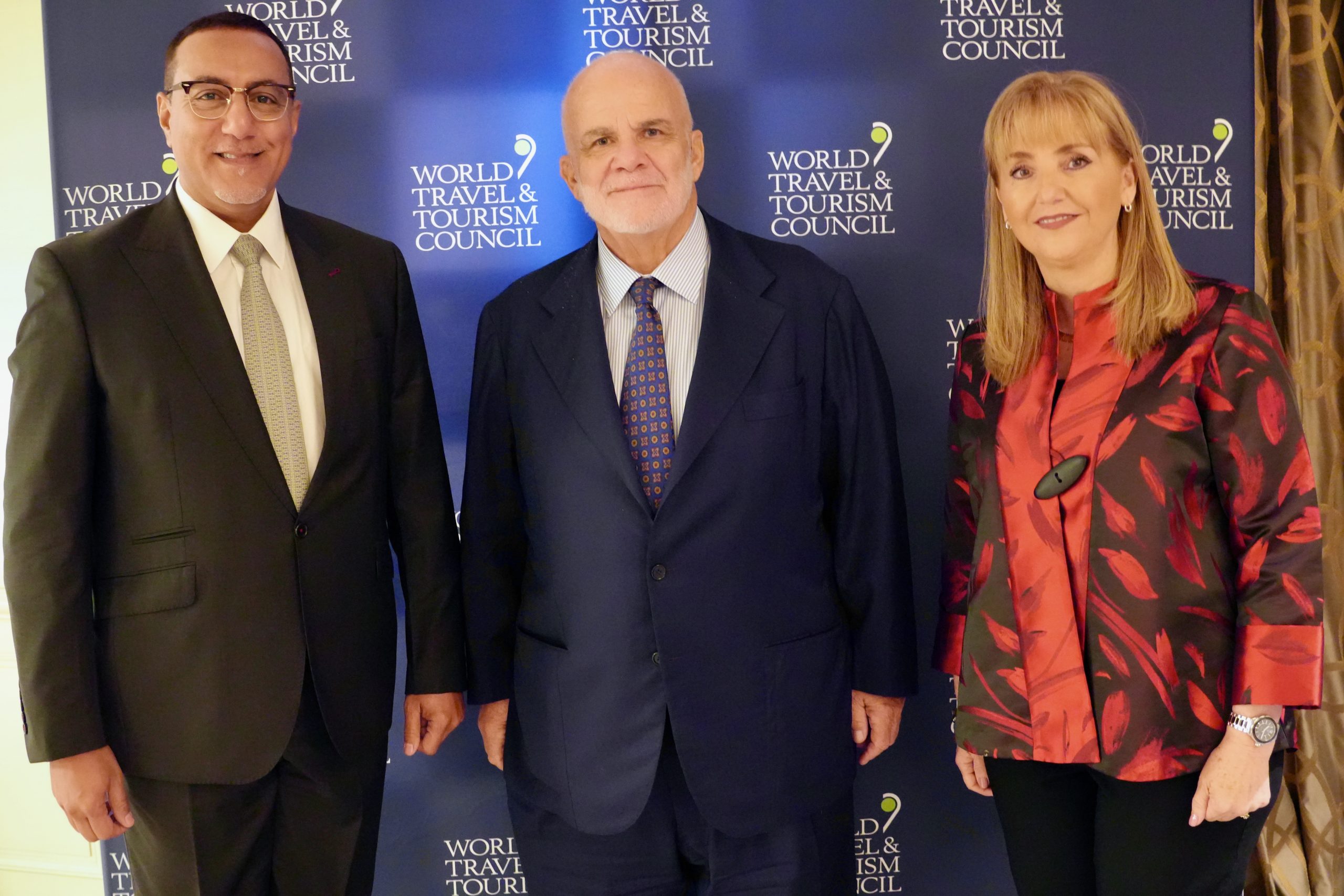
Tourism destinations recover from every major crisis and usually exceed their previous peaks within the cycle, the World Travel & Tourism Council said on May 11, launching a report drawn from 100 crisis events over four decades.
The new report seen by Emerging Travel, Accelerating Travel & Tourism Recovery – Global Evidence from Four Decades of Crises, was released aboard the Crystal Serenity as the vessel transited the Suez Canal, carrying ministers, former heads of state and sector chief executives at WTTC’s first Leadership Cruise.
No destination studied has suffered long-term collapse once a crisis has ended, according to the analysis, produced with Chemonics International and George Washington University Business School. Egypt, host of the event, was cited as a repeat example of post-crisis rebound.
The choice of venue was pointed. The Suez Canal has been at the centre of regional security debate since Red Sea shipping disruption began in late 2023, and Egyptian tourism revenues have been tested repeatedly by adjacent conflicts. Holding a recovery summit on a cruise ship moving through the waterway placed the argument and the audience in the same frame.
Travel and tourism contributed USD 11.6tn to global GDP in 2025, equivalent to 9.8% of the world economy, and supported 366mn jobs, WTTC data show. International arrivals returned to the 2019 baseline of 1.47bn by 2024 after falling 72% in 2020, and international visitor spending reached a record USD 2.02tn in 2025.
The 2008 financial crisis offered a shorter cycle. The sector recovered within two years and posted USD 1.35tn in international visitor spending by 2010.
Gloria Guevara, president and chief executive of WTTC, framed the findings as a challenge to policymakers rather than a reassurance. “The question is not whether the sector will recover, but how quickly we choose to enable that recovery,” she said.
The report sets out five principles for governments and investors: invest countercyclically at the trough, protect SMEs, maintain air connectivity as a strategic asset, avoid overreaction in messaging and policy, and use disruption to drive transformation. Recovery speed, it argues, is determined primarily by policy quality, not by the severity of the original shock.
Ibrahim Osta, senior economic growth director and global tourism lead at Chemonics International, said the pattern held across crisis types. “Across every major tourism crisis where I have supported governments and industry leaders, from geopolitical instability to terrorism and pandemics, recovery was never accidental. The destinations that emerged stronger were those that combined decisive leadership, public private coordination, and sustained support for the small businesses and communities that form the backbone of the visitor economy,” he said.
Anna Slother, president of Chemonics International, identified small operators as the constituency most exposed to the gap between crisis and recovery. “At the end of that chain are the jobs, micro-enterprises, and small tourism businesses most vulnerable to crisis and with the most to gain from effective recovery,” she said.
For Gulf carriers and CIS aviation planners currently absorbing the cost of rerouting around contested airspace, the framing of connectivity infrastructure as a strategic asset rather than discretionary spend lands at a useful moment. The report’s argument that the trough is the optimal entry point for marketing investment, air access agreements and SME credit support cuts against the instinct of finance ministries to cut tourism budgets first when revenues fall.
About WTTC
The World Travel & Tourism Council (WTTC) represents the global Travel & Tourism private sector. Members include more than 200 CEOs, Chairs and Presidents of the world’s leading travel & tourism companies from all geographies and industries.