
Live coverage | February 2026
The worst case scenario: how to crisis-proof your business
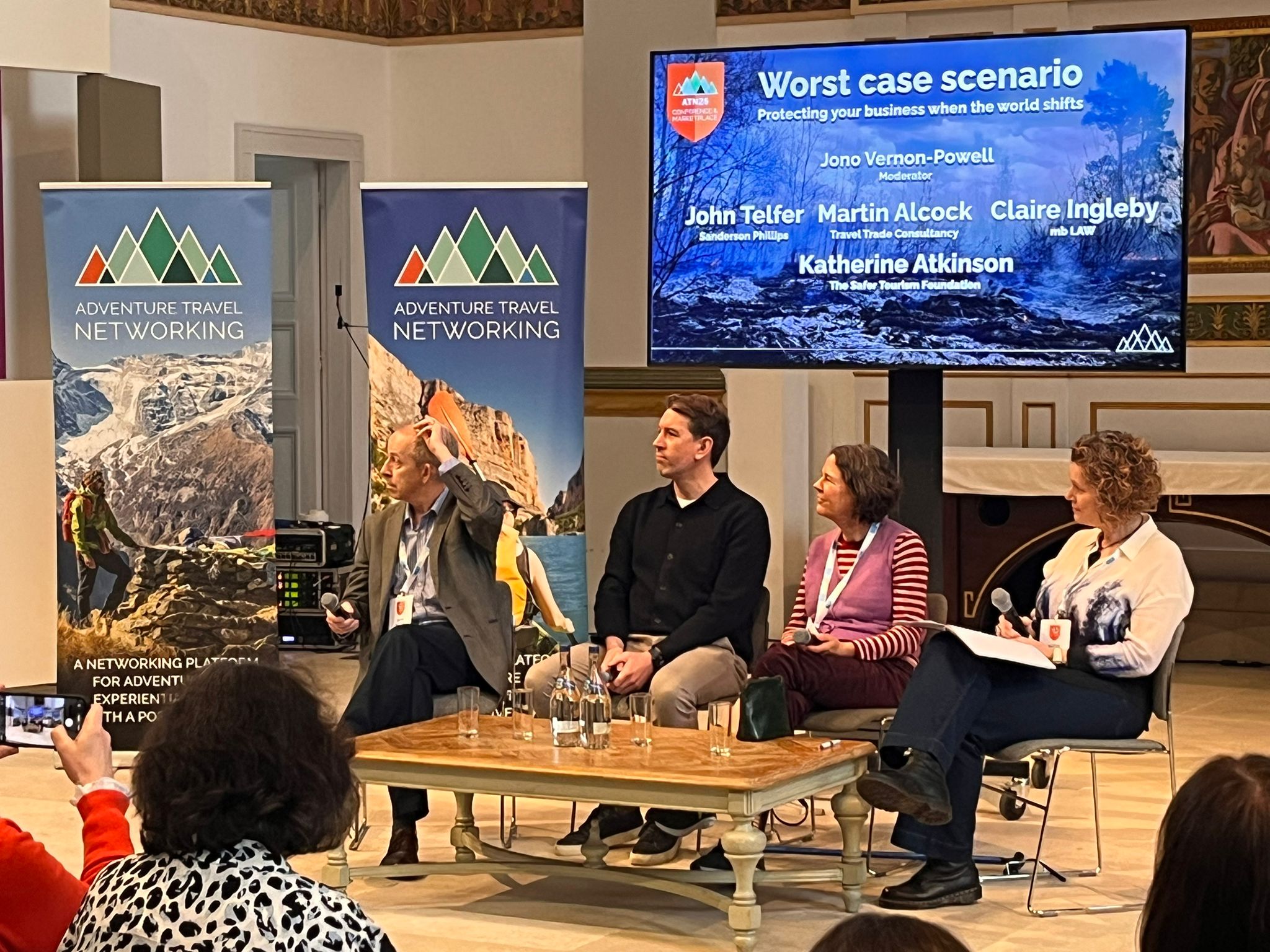
The afternoon session shifted the focus from market opportunity to existential risk, with four industry voices delivering a sobering but practical masterclass in crisis preparedness, legal liability and the underestimated role of customer behaviour in tour operator risk.
Sanderson Phillips: justify every decision before disaster strikes
John Telfer of Sanderson Phillips opened with a challenge that cut straight to the heart of operator accountability: imagine having to defend your business decisions to a coroner, a grieving family or your shareholders after the worst has happened.
“Think of your business and the worst case scenario, and how you would justify it to someone else: coroner, next of kin, shareholders,” Telfer said. “If you can’t justify it, don’t do it, even if you’ve been doing it for a long time without incident.”
He drew a sharp distinction between financial protection and reputational survival. “Liability insurance is essential for catastrophic loss, but it doesn’t protect your reputation.”
Telfer argued that the warning signs of major crises are almost always visible well in advance, pointing to COVID, SARS and Zika as examples. “We started to think about worst case scenarios and what we needed to do to be ready. Sometimes you’ll waste your time and incur losses, but that’s ok; but if it is a big event that could destroy your business or reputation, that’s what you concentrate on.”
Travel Trade Consultancy: financial dashboards save businesses
Martin Alcock of Travel Trade Consultancy brought a forensically financial perspective to crisis planning, arguing that the groundwork must be laid long before any emergency materialises.
“When you’re thinking about how to protect your business, it starts with pre-planning. I’m passionate about financial dashboards,” Alcock said. “A business needs to be quickly able to work out what the impact of changes — for example, of FCDO advice — will be, financially and operationally.”
He cited this week’s change in FCDO advice for Mexico as precisely the kind of rapidly evolving situation that demands instant clarity. “You need to be able to work out what to do within 24 hours. What’s the cash flow impact of doing the right thing? What’s the legal position? Can you afford to manage your reputation, or will it put you out of business? What’s customer money versus company money? This needs to happen quickly, and you don’t want to be doing it during a crisis.”
Alcock urged operators to extend their risk matrices to identify hidden vulnerabilities, including single points of failure that could prove catastrophic. “A crisis can evolve for a huge raft of reasons. It could be a single point of failure, like credit card processing. Be prepared. Think about what could go wrong, extending your risk matrix to identify points of over-reliance.”

mb Law: contracts manage obligation, information manages expectation
Commercial lawyer Claire Ingleby of mb Law framed the operator-customer relationship as a partnership — but one in which the legal burden falls heavily on the operator side.
“There is a heavy emphasis in legislation on the steps operators need to take to manage the risk,” she said. “But there is a balance and a need to inform and educate customers as to what they need to do. It isn’t abrogating your own responsibilities but ensuring customers play their part.”
Ingleby drew a clear distinction between two types of operator communication: “Booking conditions tend to manage obligation; general information is about managing expectations.”
She was forthright about how rarely clients engage with either before something goes wrong, and urged operators to invest in prevention rather than cure. “As a commercial lawyer, a lot of my focus is on what I can do for businesses to manage risk in advance: contracts, advice, insurance. Have a good audit trail of what you’ve done.”
The Safer Tourism Foundation: customer behaviour is your biggest risk
Katherine Atkinson of The Safer Tourism Foundation delivered what may prove the most thought-provoking contribution of the day, drawing on incident data from millions of trips to argue that customer behaviour — not operator failure — lies at the root of a significant proportion of what goes wrong on tour.
“Our experience suggests an element of what has gone wrong relates to customer behaviour,” Atkinson said. “Look at your risk matrix with that lens. You can have the best processes in the world but if the customer doesn’t want to follow your evacuation protocol or use the safety equipment, it counts for nothing.”
She introduced the concept of “holiday head” — the cognitive shift that leads otherwise sensible people to take risks they would never contemplate at home. “People are not rational decision makers and don’t behave as you’d expect. Optimism bias is strong. It makes travel a fantastic thing and is a key driver of customer behaviour.”
Atkinson highlighted climate change as an emerging and underappreciated risk, particularly for the adventure sector’s predominantly older clientele. “Increase in heat-related illness due to climate change means we are behind the curve as customers in understanding how we need to change where we go and how we behave on holiday, especially if there is a heat wave. Older clients find it harder to adjust and are more likely to have pre-existing conditions.”
She closed with a pointed reminder of how isolating a major incident can feel, alongside three practical calls to action for every operator in the room. “If a big geopolitical shift is happening, you are not alone — it’s happening to other tour operators too. But if something happens to a tourist on your trip, you can feel very alone.”
Her three challenges to delegates: consider where things might go awry if tourists do not behave as expected; think carefully about how people perceive and process risk-based information differently and ensure your risk messaging carries genuine salience; and review incident reporting systems rigorously. “Every operator needs to look at its reporting system. When something goes wrong — including near misses — how do you record it and how do you fix it in the future?”