
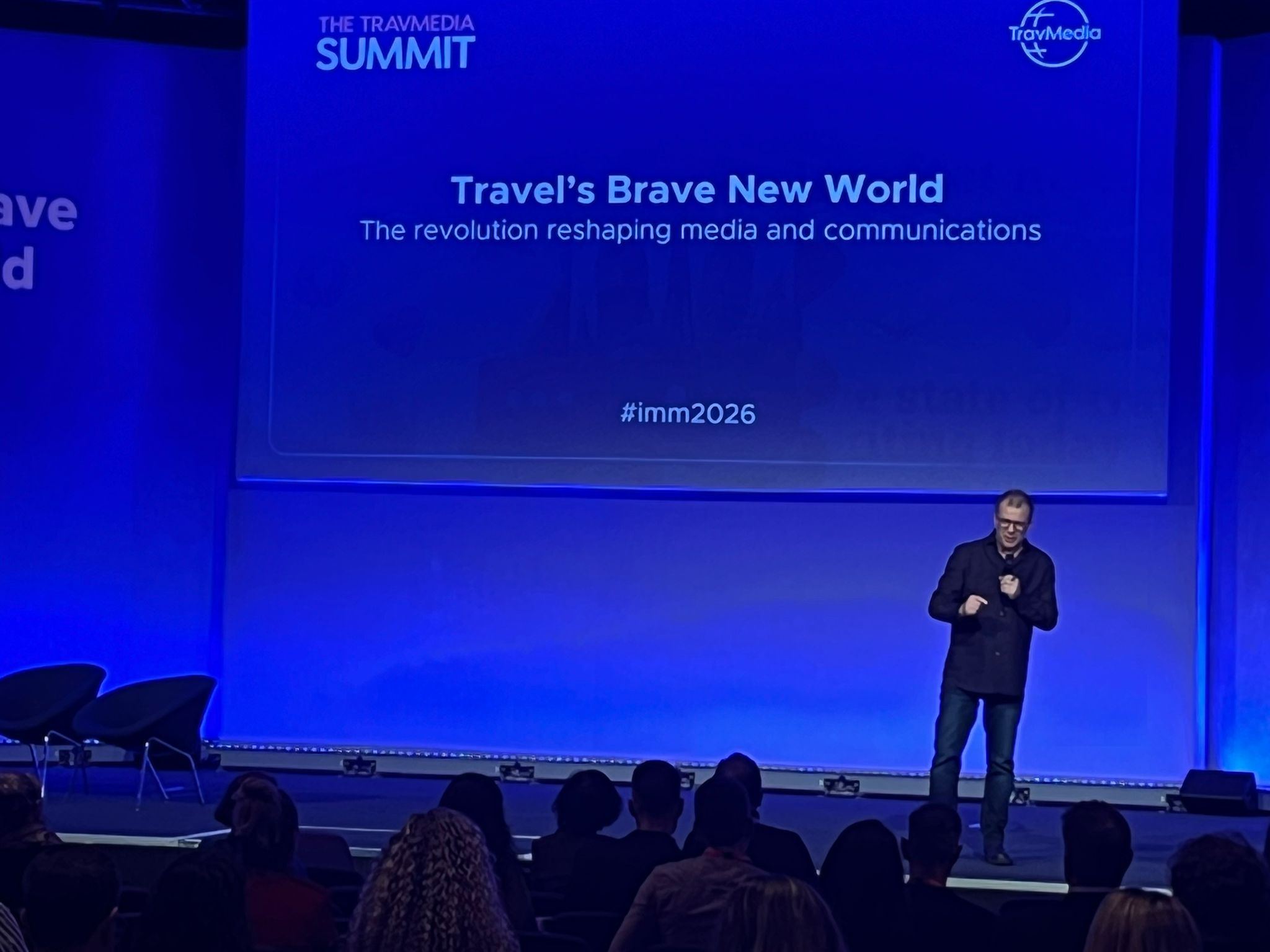
The entire basis of travel public relations must be rebuilt around artificial intelligence, with brands that fail to adapt to machine-readable content facing irrelevance, the global president of data and analytics at communications agency Golin warned delegates at the TravMedia Summit in London on March 9.
Jonny Bentwood told an audience of travel journalists, influencers and PR professionals that the shift to generative AI represented a rupture as significant as the dot-com boom or the launch of the iPhone. “Nothing is going to be the same after today,” he said. “Journalists, influencers, PRs: your jobs have to change today.”
Bentwood said the fundamental way people search for information had already changed. Where users once scrolled through search results, they now turn to generative AI platforms for a single, tailored answer. He cited data showing that 60% of Google searches now result in no click-through at all. Among Gen Z, 77% go to generative AI before any other source. In the business-to-business sector, 89% of buyers use generative AI as part of their process, and 90% click through on AI-recommended suggestions.
“The front door of the internet was Google,” he said. “That door has closed. You must now market to machines. Of course you must still market to humans, but you have to market to machines too, as that’s where your customers are going first.”
Earned Media Drives AI Visibility
Using the cruise industry as a case study, Bentwood said 92% of AI visibility is driven by citations from earned media — not brand-owned content. He noted that paywalled content is invisible to generative AI, as are Instagram and TikTok, because AI cannot yet process moving images. The platforms AI can read — and therefore the platforms brands must prioritise — include YouTube, Reddit, and Wikipedia.
He said Royal Caribbean currently leads AI visibility in the cruise sector with a 68% share, but warned that dominance in broad searches means little if a brand is absent from the niche questions real consumers ask — such as which cruise line offers the best food and drink, or which is most suitable for first-time travellers.
Bentwood said analysis of 1mn citations over a three-month period found that one third of all AI recommendations originate from an average of just five websites. “The media which answers the questions which real people ask has the most influence on generative AI,” he said.
Generative AI, he added, favours comparisons, listicles and opinion-led content that helps users decide between options. “These kinds of content dominate AI citations.”
Press releases written for machines
Bentwood urged PR professionals to optimise press releases for AI distribution via wire services, arguing that 5,000 websites receiving a wire release creates a body of machine-readable content that generative AI will draw on. “Journalists aren’t your audience; machines are,” he said.
On social platforms, he said Reddit had become the single most important channel for AI citation, describing it as an unexpected return to a much earlier era of internet culture. He advised brands to verify their Reddit profiles, engage authentically with communities, work with media outlets that republish content on the platform, and encourage existing communities to act as brand advocates.
YouTube, he said, is the most cited source on Google but performs differently on ChatGPT. The solution is straightforward: copy and paste video transcripts directly into descriptions so that AI can read them. “Contracts have to be optimised for generative AI,” he said. “This is what gets cited.”
SEO and AI are diverging
Bentwood warned that the overlap between Google search results and ChatGPT results stands at just 19% — and is falling. Each AI platform has distinct preferences: Reddit, YouTube and Wikipedia dominate general AI citations; Microsoft Copilot favours Forbes and Bing; Google AI prioritises Google, YouTube, Reddit and LinkedIn; and Perplexity favours user-generated content written in the language of the customer.
He also flagged a technical issue many brands are unaware of: websites built heavily on JavaScript are effectively invisible to generative AI.
For brand-owned websites, Bentwood outlined what he called the four Fs: whether the site can be found; the feel of the content; the format, including correct use of H1 and H2 headings and quotes; and whether the content is fresh. Semantic URLs and rich meta descriptions improve visibility, as does explicitly naming the company within content to provide validation.
He was direct about the purpose of blog content in the AI era. “I don’t care if not a single human reads your blog, even if you’re writing a blog every week: the blog is not for humans. You are marketing to machines. It’s a whole different way of thinking. This is where the money is. Get there before your competitors.”
Bentwood closed with a call to action for the PR industry, arguing that its skills in earned media, content creation and community engagement place it in a stronger position than any other discipline to lead the transition. “It’s time to rip up the PR playbook,” he said. “The world has changed. PR professionals are uniquely positioned to lead this transformation. The future has arrived. The question is: are you ready to lead?”
The summit serves as a conference for PR professionals, editors, and writers to gain insights from the industry’s most influential leaders and discuss the trends and challenges affecting the sector. TravMedia Emergingtravel.news is covering key sessions from the event.