

US travellers face the most disrupted summer airfare market in decades, with jet fuel prices nearly doubling since the start of the Iran war and the May 2 shutdown of Spirit Airlines stripping low-cost capacity from key domestic routes, according to new analysis from Dollar Flight Club.
The Seattle-based fare alert service analysed more than 500,000 airfare data points across 65 US departure airports through April 24, finding domestic summer fares running 10-15% higher year on year and transatlantic fares up roughly 20%.
Jet fuel rose from around USD 2.50 per gallon in late February to nearly USD 5 by mid-April, the sharpest cost increase US carriers have absorbed in decades. The increase is feeding directly into ticket prices on long-haul routes, where fuel makes up the largest share of seat costs.
Capacity cuts hit long-haul first
United Airlines has announced a 5% capacity reduction over the next six months, while Delta Air Lines has trimmed around 3.5%. KLM, Lufthansa and Cathay Pacific have also pulled flights. Carriers are cutting unprofitable routes first, meaning redeyes, midweek services and long-haul international are bearing the brunt.
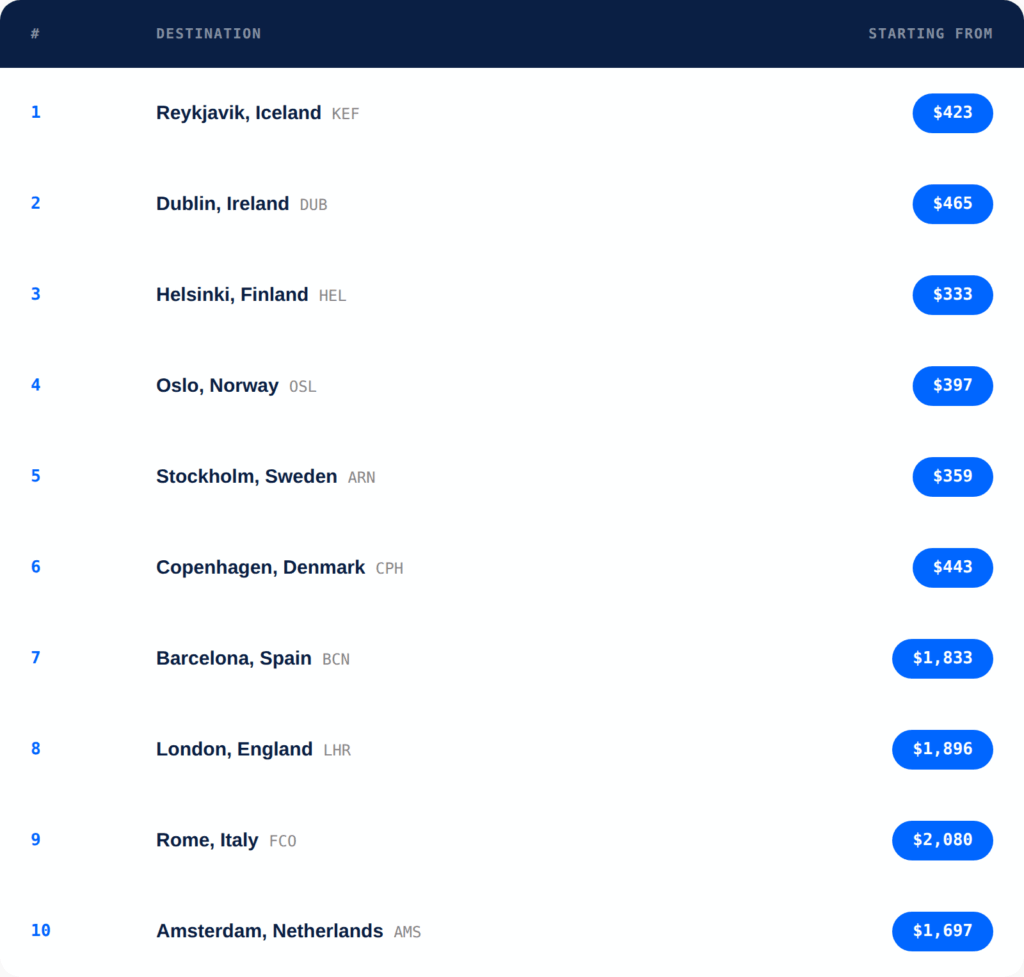
The fare impact is uneven. Transatlantic routes are absorbing the largest increases because they burn the most fuel per seat, with peak summer fares from US gateways to Paris, Rome, London, Barcelona and Frankfurt running USD 1,700-2,100 roundtrip. Short-haul services to the Caribbean, Mexico and Central America are holding up because they consume less fuel and remain dominated by low-cost carriers competing on price.
Demand has not softened despite the higher fares. United chief executive Scott Kirby told investors in March the carrier had logged its 10 biggest booking weeks in company history. Delta reported healthy demand on its Q1 earnings call.
Spirit shutdown reshapes domestic market
Spirit Airlines ceased operations on May 2, the first shutdown of a major US carrier in 25 years. Combined with capacity reductions at Frontier Airlines, the collapse has materially reduced low-cost competition on domestic routes, particularly out of Fort Lauderdale and Orlando, both former Spirit hubs.
Airlines have offered temporary rescue fares around USD 200 for stranded Spirit passengers. Dollar Flight Club expects baseline prices on former Spirit routes to rise 20-25% within three to six months as Frontier, Allegiant Air and Breeze Airways work to backfill capacity.
Where low-cost carriers remain active, prices are holding. Florida, Las Vegas and Caribbean routes continue to produce the most consistent value, with Fort Lauderdale and Orlando running under USD 150 roundtrip from a wide range of East Coast and Midwest cities.
Latin America and Canada carry the value
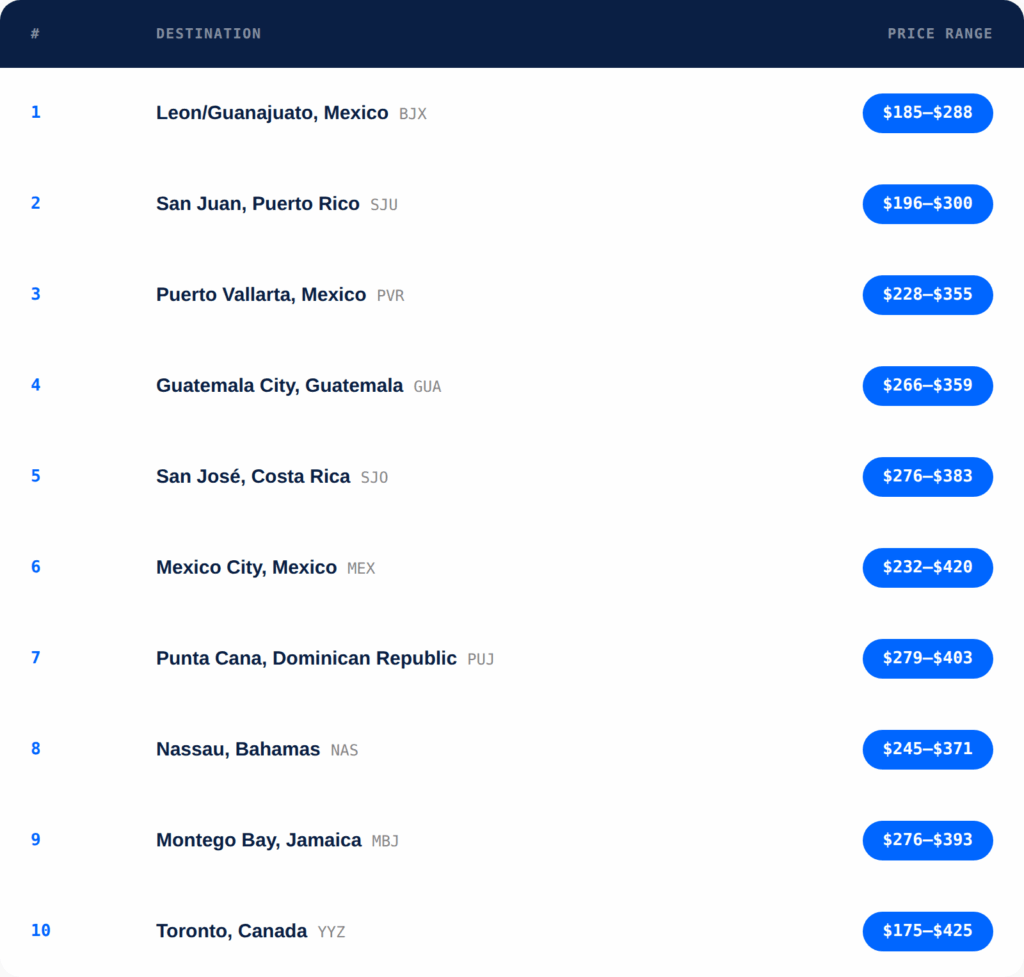
Mexico, Puerto Rico, Costa Rica, Jamaica and the Dominican Republic produced consistent sub-USD 400 roundtrips from a broad range of US departure airports. Puerto Vallarta and San Juan are showing low-end fares under USD 300, roughly 30-40% cheaper than equivalent flights to Hawaii.
Canada has emerged as a notable performer this summer. Halifax, Toronto, Montreal, Vancouver and Calgary are all producing sub-USD 400 fares, combining cheaper international travel with cooler weather than most US cities.
Northern European cities are the strongest value within Europe. Reykjavik, Dublin and Stockholm are producing the highest volume of reasonable fares, with low-end prices in the USD 350-500 range for early-season travel. Eastern European destinations such as Prague, Budapest and Vienna show occasional sub-USD 600 fares but with thinner availability.
Shoulder season offers biggest savings
Travellers able to shift trips to late August, September or October stand to make the largest savings, with European fares dropping 40-60% by mid-September. Midweek departures remain 15-25% cheaper than Friday and Sunday services, and late August is around 20% cheaper than late June.
Dynamic pricing is also playing a larger role this summer, with carriers leaning harder on AI-driven systems that adjust fares multiple times per day. Dollar Flight Club is advising travellers to book main economy rather than basic economy to preserve rebooking flexibility, and to use miles where possible given elevated cash fares.
The cool-cation trend is gaining momentum, driven both by hotter US summers and by the overlap between cooler destinations and cheaper fares. Canadian cities, the Pacific Northwest and Alaska are producing some of the most consistent value in the analysis.
Why it matters: The combination of doubled fuel costs, a major low-cost carrier collapse and uneven capacity cuts is producing a genuinely bifurcated US travel market this summer. Long-haul Europe is more expensive than at any point since the pandemic recovery, while short-haul Latin America and Canada have become the only segments where the traditional summer deal still functions. For trade, the implication is clear: short-haul leisure inventory will move; transatlantic discretionary will not.
“Travellers hoping for a fuel-crisis bargain on Europe shouldn’t hold their breath,” said Jesse Neugarten, founder and chief executive of Dollar Flight Club. “Airlines are raising fares, and people are paying them.”