

Vielha, Catalonia — Global passenger traffic will double over the next 25 years and adventure operators face a converging set of pressures from climate, AI, foreign policy and a fractured marketing landscape, the closing keynote at the Adventure Travel Trade Association’s AdventureELEVATE Europe 2026 conference heard on May 21.
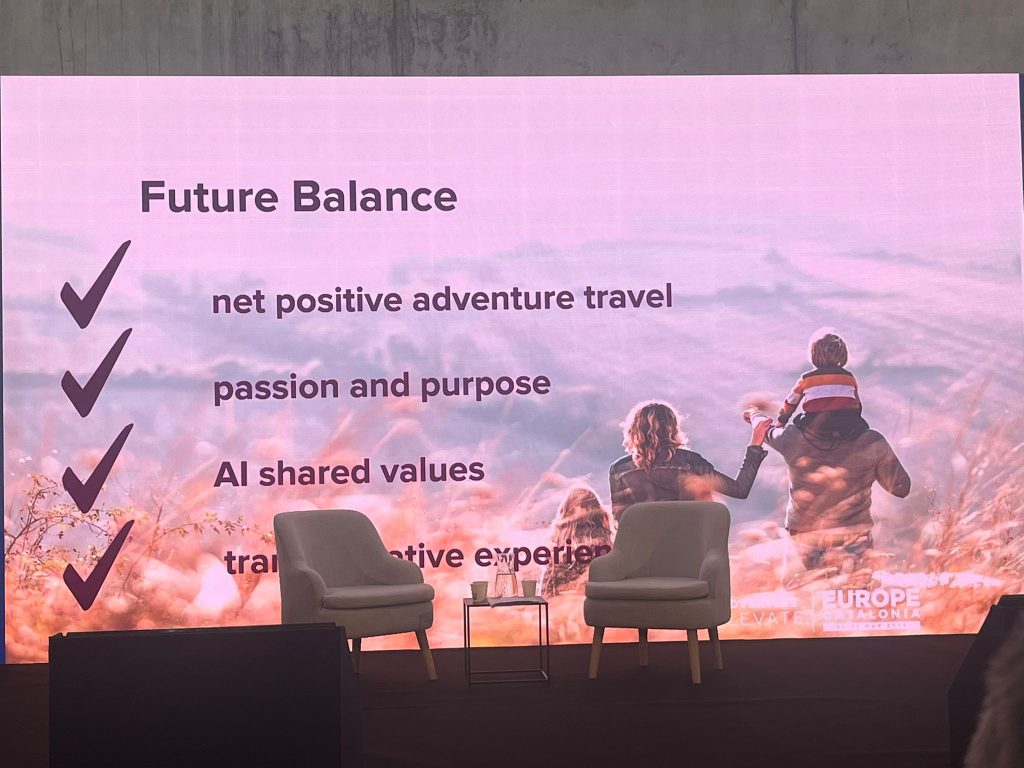
Travel investor Erik Blachford, founder of Pine5 Ventures and former CEO of Expedia, was in conversation with Caroline Bremner, managing director of Caroline Bremner Associates and a former senior head of travel and tourism research at Euromonitor International. The session at the Palau d’Esports de Vielha in Val d’Aran closed the three-day conference.
| Why it matters Adventure tourism retains 75% of customer spend in destination economies, a figure no other tourism segment can match. But the sector’s value share is declining as broader market forces reshape distribution, pricing and consumer behaviour. Operators that fail to adapt to LLM-driven discovery, mid-market contraction and shifting destination demand risk losing visibility in the channels that matter. |

A trillion-dollar segment under pressure
Bremner opened with the macro picture. Tourism now accounts for 4–5bn tonnes of carbon emissions annually, or roughly 9% of the global total. Adventure travel is a $1 trillion segment in which 75% of customer spending stays in the destination, a figure that compares with leakage of up to 80% in the most developing markets. She described that level of value extraction as “a crime of social justice”.
Despite its retention advantage, adventure’s market share is declining. Bremner flagged this as a red flag for the sector and called for sharper communication of its economic value to communities and biodiversity.
Coolcations and the demand shift
Consumer behaviour is moving away from peak-season Southern European destinations. Bremner cited projections of a 10% increase in tourism to Northern European destinations by 2100, with a corresponding 5% decline in Southern Europe, a pattern she described as the Coolcations phenomenon.
Booking.com data for 2026 shows 85% of consumers rate sustainability as important or very important, with 43% planning to avoid over-crowded destinations and 42% planning to travel off-season. Kayak data shows 84% of Gen Z and Millennial travellers would rather visit rural destinations or small cities than major hubs. Greece is positioning into adventure and wellness to extend the season and support communities, Bremner said, with similar moves across the continent.
She summarised the shift as “unfollow the herd”: capped destinations, emerging alternatives, slower itineraries, flight-free options, purpose-driven travel and off-season demand.
Five forces and the mid-market squeeze
Blachford identified five forces operators must form an opinion on: climate, AI, foreign policy, marketing and the economy. Climate regulation, he said, is unlikely to tighten meaningfully and operators should plan for more frequent floods, disasters and extreme heat.
His sharpest warning was on AI-driven labour disruption and its knock-on effect on travel demand. “If you’re running a travel business, what happens if the middle of the market has mass lay-offs? This will be very difficult for the travel market. People will delay travel,” he said.
Blachford argued that mid-range tour operators face the most exposure over the next five years. The high end will continue to grow on demand for exclusive experiences, provided operators can articulate the value, but the middle of the market is structurally vulnerable. The scale of investment behind AI, he said, makes the bet too big to fail and government intervention is not coming.
Foreign policy and the cost of getting there
Rising jet fuel and petrol prices across Europe are reducing discretionary spending on travel, Blachford said, with air fares quick to rise and slow to come down. He pointed to US administration policies making entry more difficult and expensive, with reciprocal responses likely from other markets. Trust between NATO countries, where much of the global travel market sits, has been damaged.
Marketing chaos and the LLM question
“Every marketing channel sucks right now,” Blachford told delegates. Paid channels are pricing themselves more efficiently, making it harder for operators to generate margin through advertising. AI gets the blame, he said, but the underlying issue is that the channels themselves work differently.
His advice to operators was to focus marketing investment on existing customers and reputation rather than expecting itineraries to surface in aggregators. He urged the room to think about how to gain visibility in large language models as the discovery layer shifts.
Bremner cited Booking.com data showing 54% of travellers planned or booked travel using AI in 2025, but flagged a parallel AI trust gap. Tour operators are trusted by 68% of tourists, she said, and the sector must move quickly to consolidate that position before AI tools erode it.
Wellness, loneliness and the experience premium
Bremner pointed to the $10 trillion wellness sector by 2030 as a diversification opportunity for adventure operators, but cautioned that the proposition needs to go beyond morning yoga sessions to deliver personalised wellbeing experiences combined with active travel.
Blachford framed the demand-side opportunity around what he called the loneliness epidemic. People are reacting to over-reliance on technology by choosing experiences, he said, citing the 1mn applications to run last year’s London Marathon and rising parental demand for tech-free summer camps. “When I’m on a horse I can’t check my phone,” he said.
Investment flows and the value conversation
Asked where capital is moving, Blachford named AI, solar and batteries as the dominant economic drivers. He said climate risk is being weighted less in corporate decision-making since the pandemic, with companies building what is cheapest and fastest rather than what is most sustainable.
On over-tourism, Bremner said tier-one destinations are struggling and pointed to her home city of Edinburgh as a daily example. She called for a transition to a value-based tourism model and a re-education of consumers on the true value of tourism for biodiversity and communities.
By 2050, she said, only 10 winter resorts globally will remain viable for hosting the Winter Olympics.
Growth versus limits
Neither speaker offered a clean answer to the tension between sectoral growth and sustainability. Blachford pointed to the continued global population increase and the proportion of that population emerging from poverty as structural drivers of doubling passenger numbers. Bremner said Asia Pacific will be the growth engine of the global economy and that Western markets cannot reasonably tell emerging economies not to follow the same path. Travel will become more regionalised, she said, as prices rise.
Blachford closed with a caution against overreaction. “There’s this feeling that because people use a different platform to find you, they are different people. But they’re not. The AI bookers are the same people who used Google three years ago,” he said.