
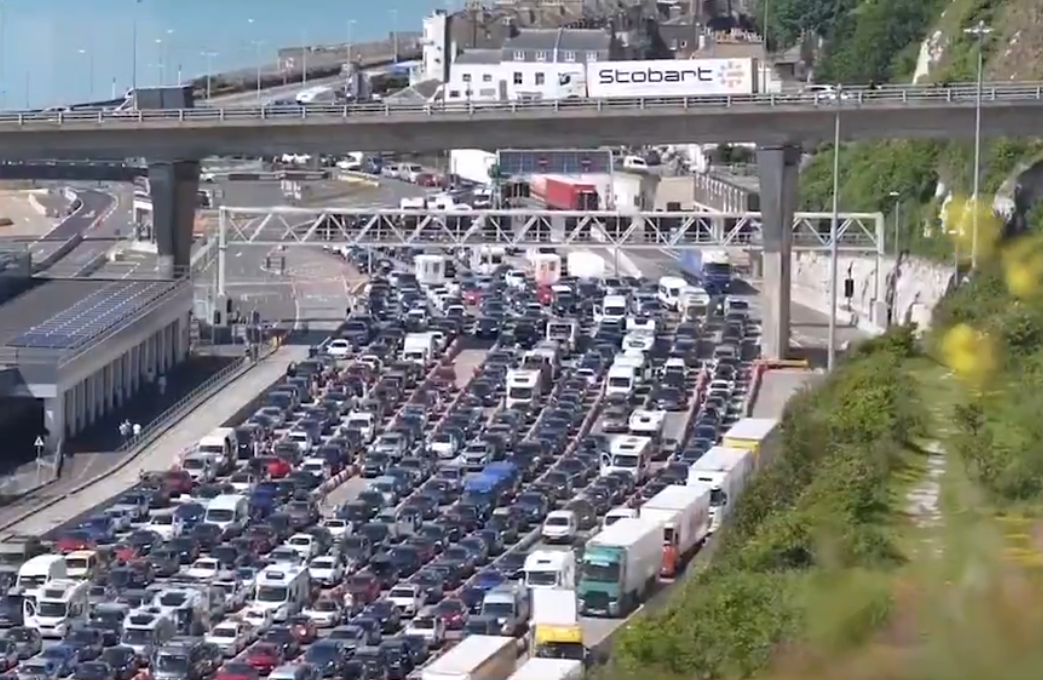
French border police have suspended full EU Entry-Exit System biometric checks at Britain’s Port of Dover during the bank holiday weekend, with French authorities manually processing travellers at the eastern docks after hour-long queues built up by early Friday morning, ITV News reported on May 23.
The Port of Dover said the full EES system was not running for car passengers and that it was still awaiting delivery and installation of French technology, with French border police manually creating traveller records at the eastern docks instead in the latest sign of strain on the new EES system which was much vaunted by Brussels but aggresively opposed by the UK and countries where British holiday makers usually go to. EES has been repeatedly delayed since its original launch date in 2022, with France’s technical failures, infrastructure constraints at Dover’s white-cliff-hemmed footprint and political resistance from operators combining to push back full implementation.
Dover and Eurotunnel are still awaiting a green light from French officials before applying full EES checks to car passengers. Currently only Eurostar first and Carte Blanche holders are required to register, while Dover is processing only coach passengers under the system in what has been the latest nightmare for countires.
Emerging Travel News writer @james-nute previously highlighted the same problem in Poland on a recent low-cost city excursion to the Polish city of Krakow well ahead of the bank holiday and warmer weather.
Manul processing
The manual processing approach is a direct response to queue pressure. French port borders have seen software failures in pre-registration kiosks and tablets preventing their proper use, and the Union des Ports de France has warned of “serious risks of congestion and disorganisation” at border crossing points, calling for an urgent meeting with the ministers for interior and transportation.
France’s interior ministry is grappling with hardware and software problems, with kiosks and tablet-based Pre-Registration Devices at Paris-Charles de Gaulle, Nice, the Eurostar terminals and major ferry ports still failing to capture fingerprints or interface reliably with the central EU database. A government source admitted that only around one third of non-EU travellers had been successfully enrolled, well short of the 50% threshold France was meant to achieve by March 10.
Eurotunnel estimates the average time for processing a car through the French frontier will rise from under 60 seconds to between five and seven minutes once full biometric checks are applied, a six-fold increase that is the primary reason the rollout for private cars at Dover was pushed back.
Belgian authorities have also announced they will delay full registration of all travellers with biometrics due to long airport queues, and plan to ask the EU to agree a more realistic calendar.
European families already strained by balooning prices are likely to reduce their upcoming travel plans during the summer holiday period with cancellations reported in several destinations already. This could potentially lead to a knock-on effect for OTA and other travel agents in the next few months targeting UK sales.
Why it matters for the trade
This is the first major bank holiday weekend since EES went live for coaches and freight, and the manual processing fallback at Dover is already producing hour-long waits before peak summer volumes arrive. For agents and operators selling cross-Channel product, the practical read is straightforward: advise clients travelling by ferry or Le Shuttle to budget extra time at Dover and Folkestone until the system stabilises.
The full biometric rollout for car passengers has no confirmed date, meaning the current manual processing bottleneck is likely to persist through the summer peak.