
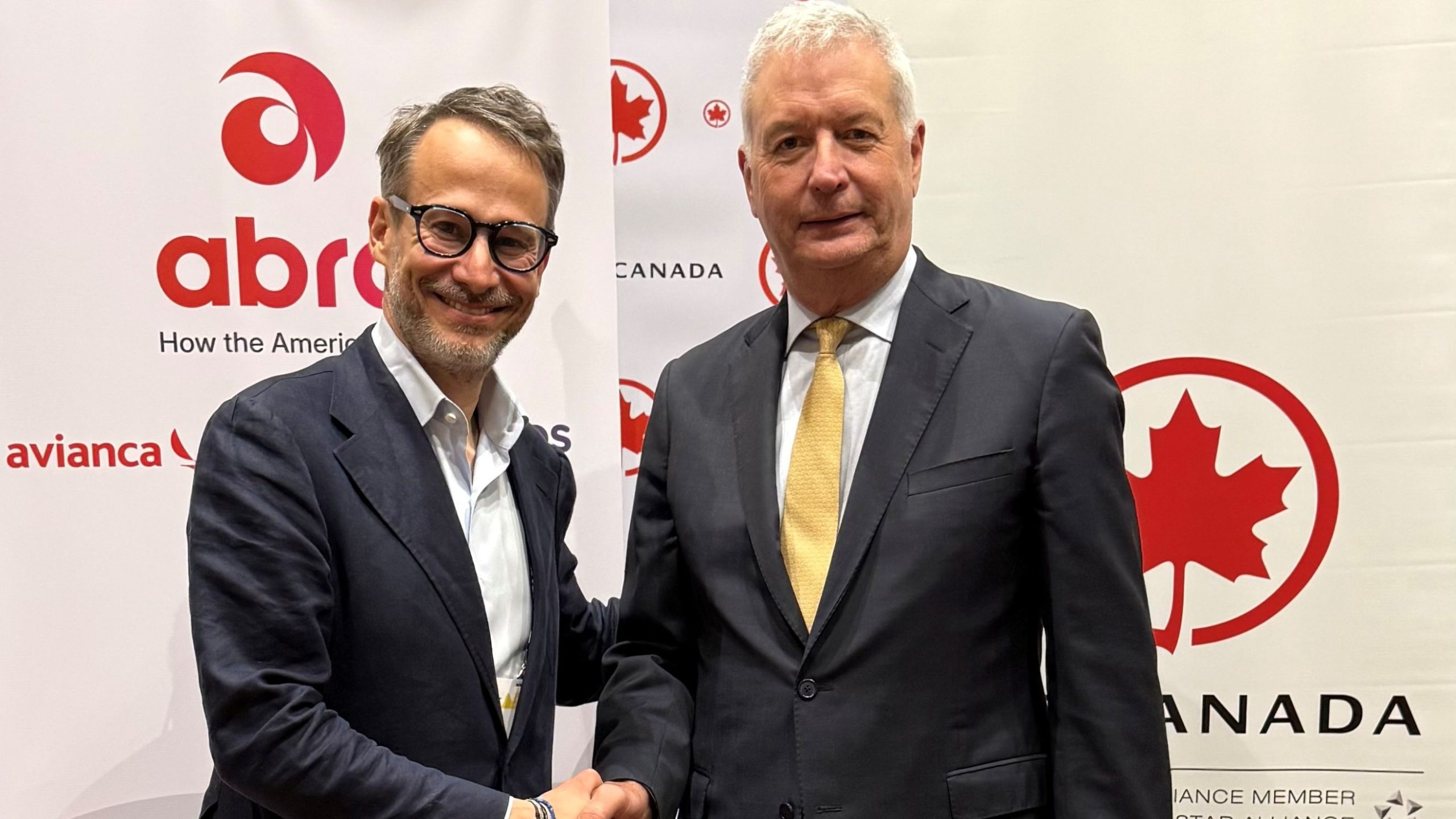
Air Canada and Abra Group have signed a Memorandum of Understanding (MOU) to build a long-term strategic partnership spanning North, Central and South America, the carriers announced from Rio de Janeiro on June 7.
The agreement pairs Canada’s flag carrier with the Latin American group behind the Avianca and GOL brands, opening a pathway towards a Joint Business Agreement, expanded codeshare and revenue sharing on select Canada–Latin America routes. Any final deal remains subject to documentation and Canadian regulatory approval but would open up the southern markets and potentially reduce prices for connections to South America
The proposed tie-up builds on existing codeshare arrangements and Air Canada‘s Star Alliance relationship with Avianca, alongside a longstanding collaboration with GOL. Under the framework, the partners would coordinate sales and distribution, align airport services, baggage policies and disruption management, and strengthen frequent-flyer reciprocity across the Aeroplan, LifeMiles and Smiles programmes. Cargo cooperation is also on the table, with both sides signalling appetite for more integrated freight solutions to support growing hemispheric trade flows.
Air Canada is leaning into a market it sees accelerating. The carrier has been expanding into Lima, Santiago and Rio de Janeiro, with Quito growth flagged ahead. Abra, for its part, brings roughly 30,000 employees, a fleet of more than 300 aircraft and scheduled service to over 145 destinations across 25-plus countries, plus a strategic stake in Wamos Air and convertible debt linked to Sky Airline.
Why it matters for the trade
For agents and corporate buyers, a Joint Business Agreement of this scale would reshape how Canada–Latin America itineraries are priced and sold. Coordinated distribution typically means tighter fare alignment and more through-fares across previously separate networks, simplifying complex multi-stop bookings through Canadian gateways.
The loyalty integration is the immediate sweetener: members earning and burning across three sizeable programmes widens the value proposition for frequent travellers and the advisers who book them.
Cargo operators should watch the freight component closely, as combined bellyhold and freighter capacity across the Americas could open new lane options for forwarders.
The caveat throughout is regulatory: JBAs require antitrust immunity in multiple jurisdictions, so the trade should treat this as a direction of travel rather than a live product. Expect a long runway before any of this reaches the booking screen.