
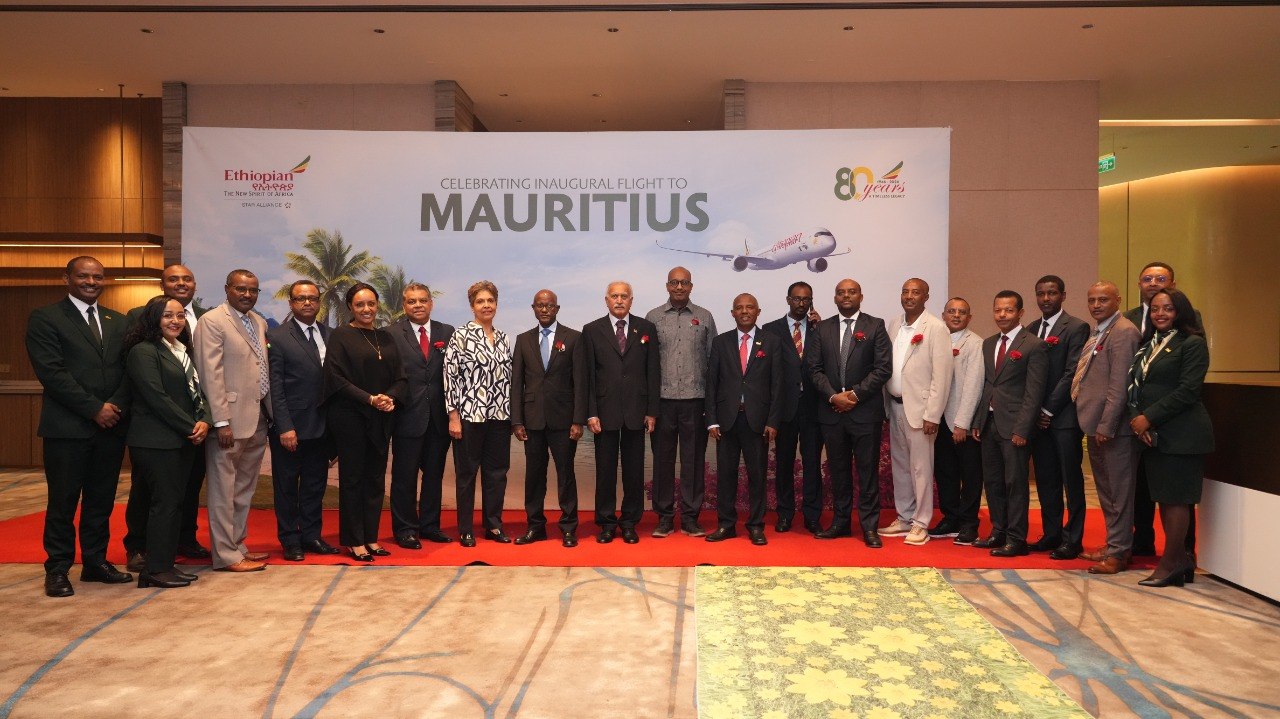
Ethiopian Airlines has inaugurated a three-times-weekly passenger service between Addis Ababa and Mauritius, the carrier announced on July 12, extending Africa’s largest airline into the Indian Ocean leisure market.
The route connects Mauritius to the Star Alliance member’s hub at Addis Ababa Bole International Airport, giving the island one-stop access to Ethiopian’s network of more than 160 passenger and cargo destinations across Africa, Europe, Asia, the Middle East and the Americas.
“Mauritius is a destination of remarkable beauty, rich culture, and growing economic importance,” said Ethiopian Airlines Group chief executive officer Mesfin Tasew. “As a Pan-African airline, Ethiopian will continue to serve as a catalyst for enhanced air connectivity between Africa and the rest of the world.”
The carrier said the service is intended to support trade, tourism and people-to-people links between the two countries, and framed the launch as part of its wider strategy of expanding intra-African connectivity through the Addis hub.
Ethiopian operates a fleet including Boeing 737s, 777s and 787s, Airbus A350-900s and A350-1000s and De Havilland Q400s, and is pursuing a multi-hub strategy through ASKY in Lomé, Malawi Airlines in Lilongwe, Zambia Airways in Lusaka and Air Congo in Kinshasa. The group is working towards its Vision 2035 plan to become one of the world’s top 20 aviation groups.
Why it matters for the trade
Mauritius has a connectivity problem that this route directly addresses. The island’s air links are heavily weighted towards its traditional source markets, with Air Mauritius and European carriers serving Paris, London and the continent, and Emirates funnelling long-haul traffic through Dubai. African connectivity, by contrast, has rested largely on the Johannesburg and Nairobi corridors.
A three-weekly Addis Ababa service changes the geometry: Ethiopian’s hub offers among the widest one-stop coverage of West and Central Africa available anywhere, opening Mauritius to markets such as Nigeria, Ghana and Côte d’Ivoire that were previously two stops away, and giving the island’s tourism authorities a credible route to the African middle-class traveller they have been courting as part of source-market diversification.
The eastbound logic matters just as much. Addis has built substantial connecting traffic between Africa and Asia, and this route gives agents in India and China, two markets Mauritius has targeted hard, an alternative routing with Star Alliance earning. For the MICE and honeymoon segments that drive Mauritian yield, an additional alliance carrier also strengthens corporate booking channels.
Three weekly frequencies are a toe in the water rather than a statement, and history suggests Ethiopian will scale the route if cargo and connecting loads perform. Operators packaging the Indian Ocean should also note the twin-centre potential: Addis connectivity puts Ethiopia’s own growing tourism circuit within one stop of a Mauritius beach stay.