
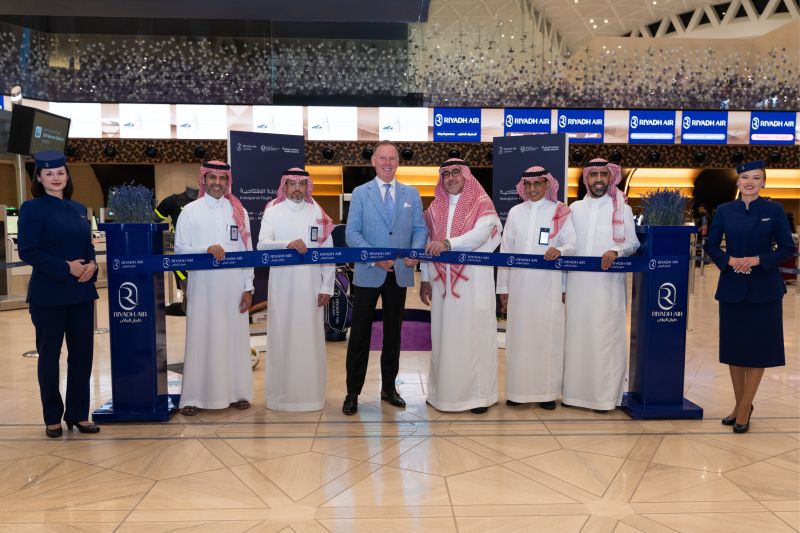
Riyadh Air operated its inaugural Riyadh to Madrid service on July 17, launching four weekly flights on a route developed with the Saudi Air Connectivity Program.
Madrid is the carrier’s second European destination after London and lands on the date announced when ticket sales opened on June 7, a point worth noting for a start-up airline whose network plans have previously been reshaped by Boeing delivery timing. Riyadh Air flew its first commercial revenue flight in October 2025 and is building towards more than 100 destinations by 2030, with Manchester due to follow on July 23.
The involvement of the Air Connectivity Program is the commercial substance here. ACP is the Saudi state vehicle that underwrites route development, and its presence signals that Madrid is being supported into the network rather than opened purely on demonstrated demand.
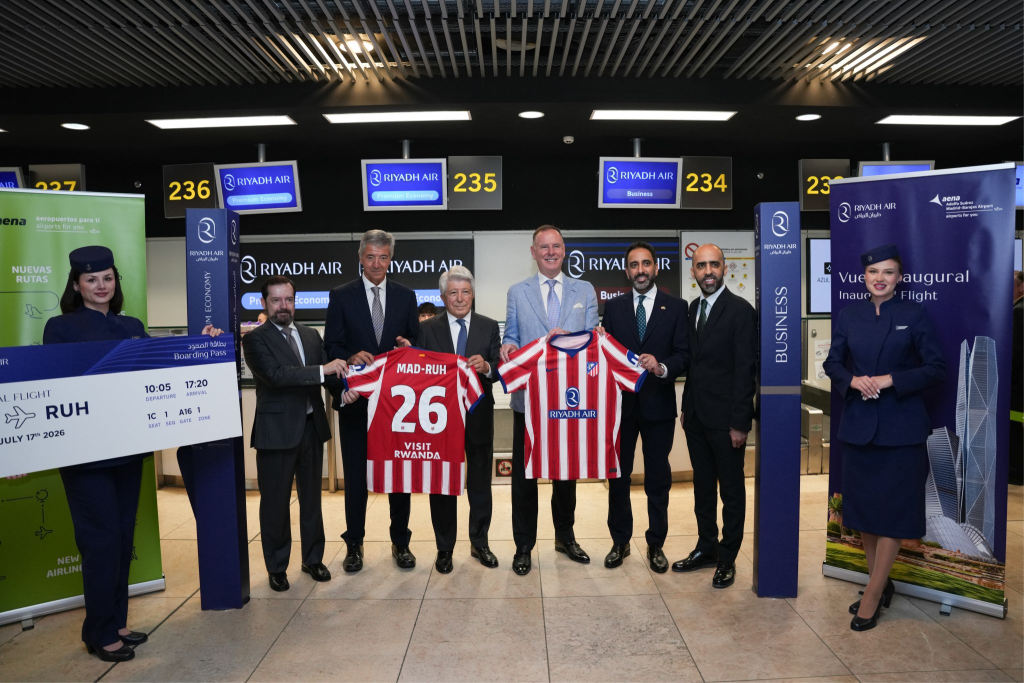
Riyadh Air marked the inaugural alongside Club Atlético de Madrid, with which the carrier holds a partnership.
The airline is wholly owned by the Public Investment Fund and operates Boeing 787-9 Dreamliners configured in four cabins seating 290 passengers. It holds firm orders for 39 787-9s, 60 Airbus A321neos and 25 A350-1000s.
Four weekly is the tell. A daily service says the airline believes the point-to-point market stands on its own. Four weekly says Madrid is being built, and that connecting traffic over Riyadh is doing part of the work. For agents, that means schedule gaps on three days a week and a connection bank that has to be checked rather than assumed, particularly for onward Asian itineraries where Riyadh Air’s network is still thin.
The ACP involvement matters more than the ribbon-cutting. Route development funding changes the risk calculus on frequency growth: a supported route can hold a schedule through a soft first year that a commercially standalone route could not. Operators planning Spain-Gulf product on Riyadh Air can reasonably expect the four weekly to survive the winter, which is not always a safe assumption with new carrier route launches.
Spain is also the outbound half of this. Riyadh Air’s framing is inbound, positioning the route as a channel for Spanish travellers to discover Saudi heritage and culture, and that is where the trade opportunity sits for Spanish tour operators and DMCs. Saudi Arabia has had almost no direct lift from the Iberian market, and AlUla and Diriyah product has been sold into Spain via Gulf connections at a cost and journey-time penalty. Direct Riyadh access changes the shape of what can be packaged.
