
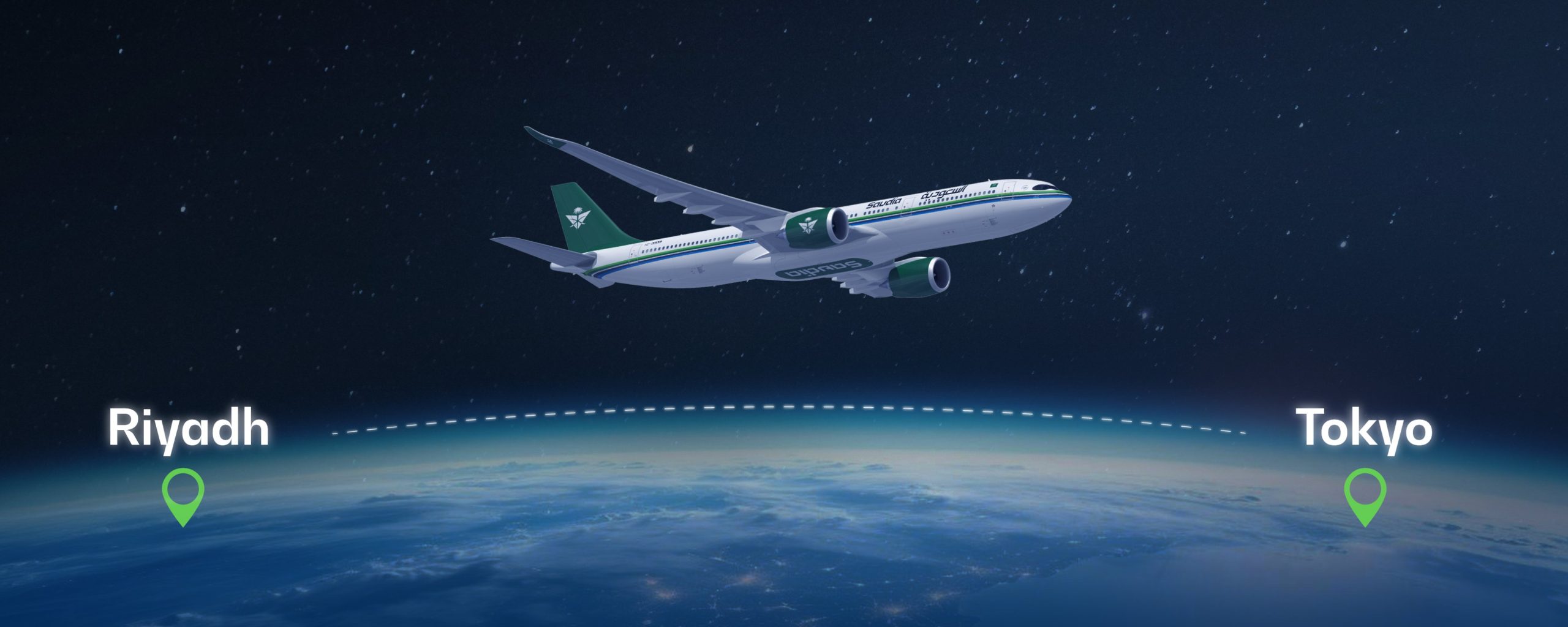
Saudia will launch three weekly flights between Riyadh and Tokyo from November, giving Saudi Arabia and Japan their first scheduled nonstop passenger link, the carrier announced on July 15.
The route from King Khalid International Airport is being launched in collaboration with the Air Connectivity Program, the Saudi body that co-funds route development into the kingdom, and the Saudi Tourism Authority. Flights are already on sale through Saudia’s digital channels and authorised sales outlets.
The flag carrier said the route supports the National Aviation Strategy, the National Tourism Strategy and Saudi Vision 2030, and framed the timing around the kingdom’s hosting of the AFC Asian Cup 2027, saying the service will support travel for Japanese fans and visitors. The Saudi Tourism Authority is working with Japanese travel-sector partners and agencies on packages and destination promotion to drive inbound traffic.
Saudia currently serves more than 100 destinations across four continents with a fleet of 153 aircraft, and has 112 aircraft on order under an expansion programme intended to position Saudi Arabia as an aviation and tourism hub.
The announcement did not specify which Tokyo airport the service will use, the operating days or the aircraft type. All current Riyadh-Tokyo itineraries involve connections through hubs including Istanbul, Doha, Dubai and Abu Dhabi.
Why it matters for the trade
Japan is one of the highest-value source markets in global travel, and until now Saudi Arabia has had no nonstop access to it. Every Japanese visitor to the kingdom, and every Saudi traveller to Japan, has connected through Turkish, Gulf or East Asian hubs, adding four to eight hours each way.
A nonstop cuts that friction precisely as the kingdom courts the markets its tourism strategy calls “high-yield long-haul”, and the involvement of the Air Connectivity Program signals this is a strategically subsidised route that will be given time to mature rather than judged on early loads.
For Japanese outbound operators, Saudi Arabia is a genuinely new product: AlUla, Diriyah and the Red Sea resorts map well onto the Japanese appetite for heritage, craftsmanship and high-end resort stays, and the Saudi Tourism Authority’s package-building work with Japanese agencies suggests trade support will be in place at launch.
The Asian Cup 2027 angle is more than window dressing. Japan is the most successful side in the tournament’s history and travels with large, high-spending supporter groups, and a November 2026 launch gives the route a year to bed in before the tournament.
The unknowns worth chasing before clients book: which Tokyo airport, since Haneda’s slot scarcity would make Narita the likelier bet; the operating days, which determine whether the schedule works for five-night packages; and the aircraft, which will indicate premium cabin availability. Worth also watching whether Riyadh Air, the kingdom’s second flag carrier, follows into Northeast Asia, which would confirm Tokyo as a strategic corridor rather than a one-off.