

One in three UK travellers are now using artificial intelligence tools to plan holidays, marking a shift away from search engines and travel agents in parts of the travel planning process, according to research from global marketing network dentsu released on May 21.
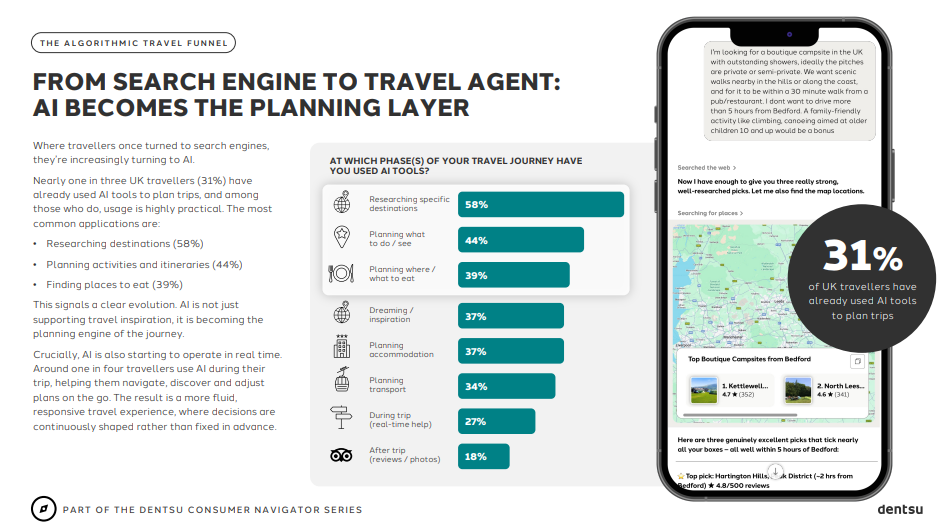
The findings, published in dentsu’s latest Consumer Navigator report, show 31% of Britons use AI when planning a getaway. Among those using the tools, 58% use them to research destinations, 44% to plan activities and 39% to find places to eat.
More than a quarter of travellers also use AI during trips, according to the research, using it to navigate, find places and alter plans while travelling. The report said this is making holiday planning less fixed in advance, with decisions changing during the trip.
Social media remains an important source of travel inspiration, but the research suggests it has a trust problem. Nearly half of respondents said social media influences where they travel, while only 12% said they trust what they see.
Travellers are instead using social media for ideas before checking them through AI and other sources before booking, the research found.
Katie Camenzuli, managing partner at iprospect, a dentsu company, said AI was becoming a central part of travel planning.
“We’re seeing a fundamental shift in how people plan travel. AI is no longer a novelty, it’s becoming the backbone of the travel planning process,” Camenzuli said.
“What’s changing is not just the tools people use, but the speed and confidence with which they make decisions. Travellers are moving faster, but they’re also expecting more personalised, reliable and seamless experiences,” she said.
Chris Davies, head of strategy at Carat, a dentsu company, said the travel planning process had moved away from a single route from inspiration to booking.
“For travellers, that means more control and better decisions. But it also raises expectations, people want information that’s useful, trustworthy and immediately actionable,” Davies said.