
By Bill Perceval-Maxwell
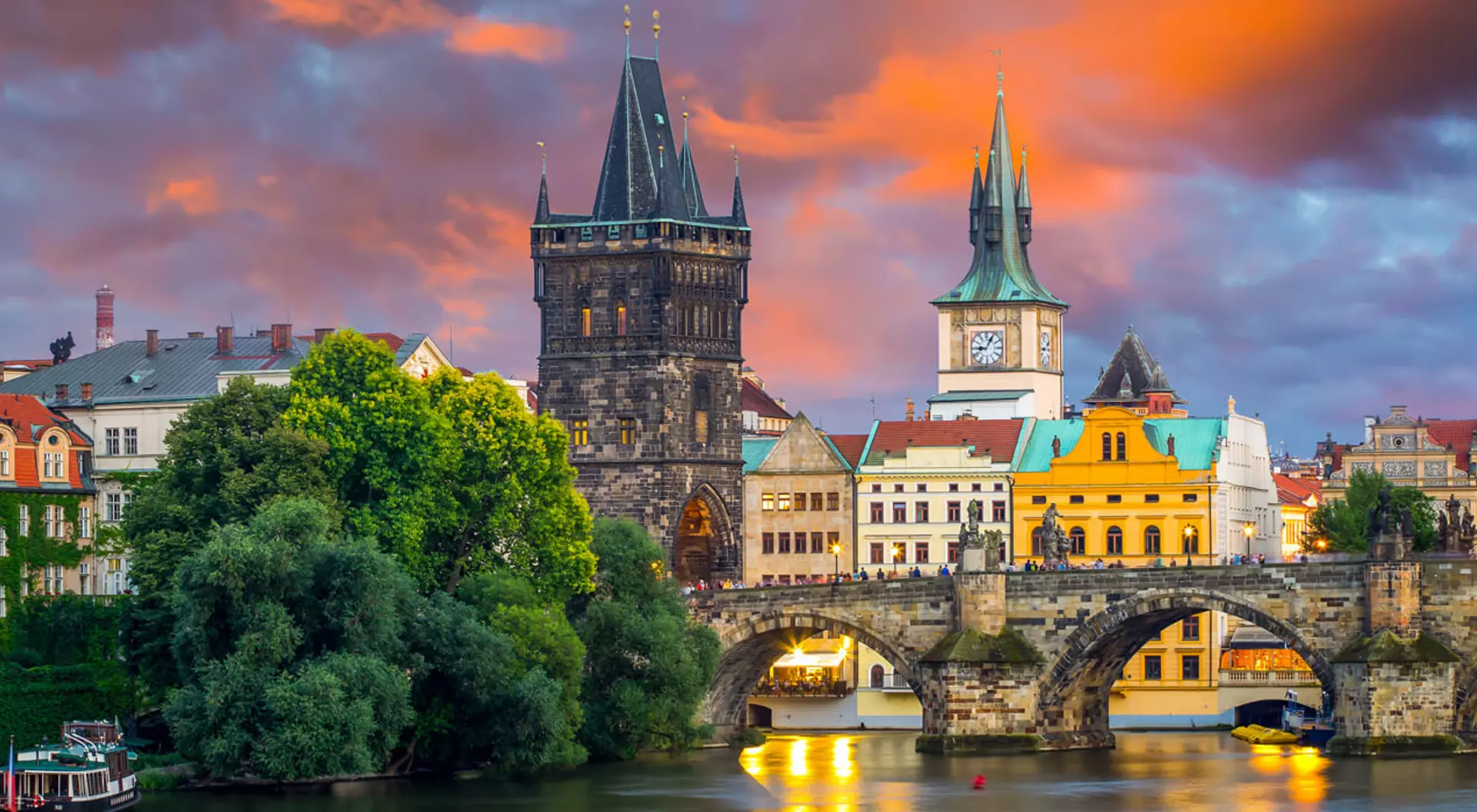
I have lost count of how many times I have walked across the Charles Bridge. Prague rewards repetition. It is one of the few European capitals where the historic core survived the twentieth century more or less intact, and where a client with three days and a little curiosity can still feel they have discovered something. What follows is my own guide, built up over years of going back. I have kept it personal on purpose. The trade value, I think, lies in the detail.
Eating, drinking and the matter of Czech wine
Start with U Maltíře on Maltézské náměstí, just off Malostranské náměstí in the Lesser Town. Order any game dish. This is also one of the few places in the city where you can drink Czech red wine without feeling someone has poured you red ink cut with battery acid. The French list is excellent, but it carries a premium.
Palffy Palác on Valdštejnská, also in the Malá Strana and tucked just under the Castle, occupies a fine old palace that once belonged to a major Bohemian family. It works for lunch as well as dinner. In good weather you sit out on the balcony.
The Lobkowicz Palace Café inside the Castle complex at Hradčany is my pick for a midday stop. The views over the whole of Prague are magnificent and the food is mercifully light by Czech standards. Get there early. The attached museum is one of the best in the city, full of returned art and musical scores belonging to a family who were once Beethoven’s patrons. The English audio guide is recorded by William Lobkowicz himself.
Obecní dům, the Municipal House near the Powder Tower in the Old Town, is a must. This was the centre of Prague life in the 1920s, during the First Republic, and the Art Deco interior is a thing of wonder. The cakes and hot chocolate are especially good. There are often worthwhile art exhibitions upstairs and major concerts in the main hall. The Powder Tower is round the corner and worth the climb.
Café Slavia, opposite the National Theatre on the river, was a gathering place for the literati in the 1920s. Service can be slow, but it earns its place for a pre-theatre bite.
A word on one piece of recent change. The old Hotel Evropa on Wenceslas Square, long a handy hot chocolate stop, closed its doors in 2013 and has reopened as W Prague, marking the entry of W Hotels into the Czech Republic. The renovation spanned over 10 years. The ground-floor Grand Café Evropa, which Kafka is said to have read in, is once again luxurious and back in business, though it now sits at a different price point. Useful to know if a client asks.
Beer
Pilsner, and frankly all beer, is good everywhere. You will see světlé (pale) and tmavé (dark) pivo on every list, so try both. Na zdraví. The best Pils in Prague was for years served at the Golden Tiger (U Zlatého tygra) on Husova, though it gets mighty busy.
U Fleku on Křemencova, on the Old Town side not far from the National Theatre, is unashamedly touristy. But the dark beer brewed on the premises for over five hundred years remains wonderful. The food is robust. Better value is to be had elsewhere.
Shopping
The shops on Na Příkopě, which crosses the bottom of Wenceslas Square, and on Pařížská, which runs north off the Old Town Square, tend to be the most reliable, if pricier.
Glass and garnets are the two perennial tourist buys. Good glass, meaning well-coloured with limited or no etching, is best found at Moser on Na Příkopě, though it is expensive and awkward to carry home on the plane. If you come across Artěl glass, that is also worth buying. There is an excellent bookshop halfway up Wenceslas Square on the right. The best CD shops are over on the Castle side, with one on Loreto Square particularly good. For old prints, try the antiquarian dealer on a side street off Pařížská.
The sights
Hradčany, the Castle. St Vitus Cathedral, the Castle Gardens for the view, and the Old Palace. Vladislav Hall is an absolute must. The medieval architecture is astonishing, and you can see the windows the Vienna envoys were thrown out of, an act that started the Thirty Years’ War. Walk west out of the Castle and the Archbishop’s Palace, with its gallery, is worth a look. So is the Loreto, and best of all the Strahov Monastery, which has splendid views and two beautiful libraries. Kafka’s house on Golden Lane gets very busy, and even entering the lane now costs money.
Malá Strana. St Nicholas Church, a huge Baroque edifice. Nerudova, the climb up to the Castle. The Kafka Museum on the river. The Lesser Town Square and the approaches to the Charles Bridge.
Old Town. The Old Town Square. The Týn Church, a parachutist’s nightmare given all those spikes. The Royal Route from the square to the Charles Bridge. The Jewish Quarter, though that can be emotionally draining. And the Church of St Cyril and St Methodius, where the assassins of Reichsprotektor Heydrich made their last stand after being betrayed in 1942. Go down to the crypt.
If you have time, add Villa Bertramka, the house of Mozart’s friends, the Vyšehrad cemetery and church, and the National Museum on Wenceslas Square.
Music
For concerts and opera, the Theatre of the Estates (Stavovské divadlo) is where Don Giovanni had its first performance in 1787, so see Mozart there. The Rudolfinum on the river is home to the Czech Philharmonic, the place for Brahms, Smetana and Dvořák. Your hotel will advise, but go to the box office yourselves so you can see where you will be sitting. Jazz can be very good. Check locally for where the hotspots are this season.
Have fun. Prague does not disappoint.
Why it matters for the trade
Prague sells itself on the obvious: the bridge, the Castle, the cheap beer. The opportunity for operators and travel advisers is in the layer beneath that, and this guide is built around it.
The reopening of the Hotel Evropa as W Prague is the headline change. It adds a recognised international luxury flag on Wenceslas Square and signals a continued upgrading of the city’s five-star inventory, alongside other recent and forthcoming openings. For advisers selling Prague at the top end, the supply story is now materially better than it was even three years ago.
The wider point is that Prague carries a reputation problem at the budget end, the stag-weekend cliché, that suppresses higher-yield business. Clients who are steered towards game restaurants with drinkable Czech reds, palace cafés with light lunches, returned-collection museums and box-office classical seats spend more, stay longer and come back. The cultural and historical density, from First Republic Art Deco to the Heydrich crypt, supports genuinely differentiated itineraries that a competent adviser can charge for.
The practical takeaways: position Prague as a three-night cultural city break rather than a two-night party stop; lean on the strengthened luxury hotel supply; and build product around food, music and history rather than price. The margin is in the curation.