
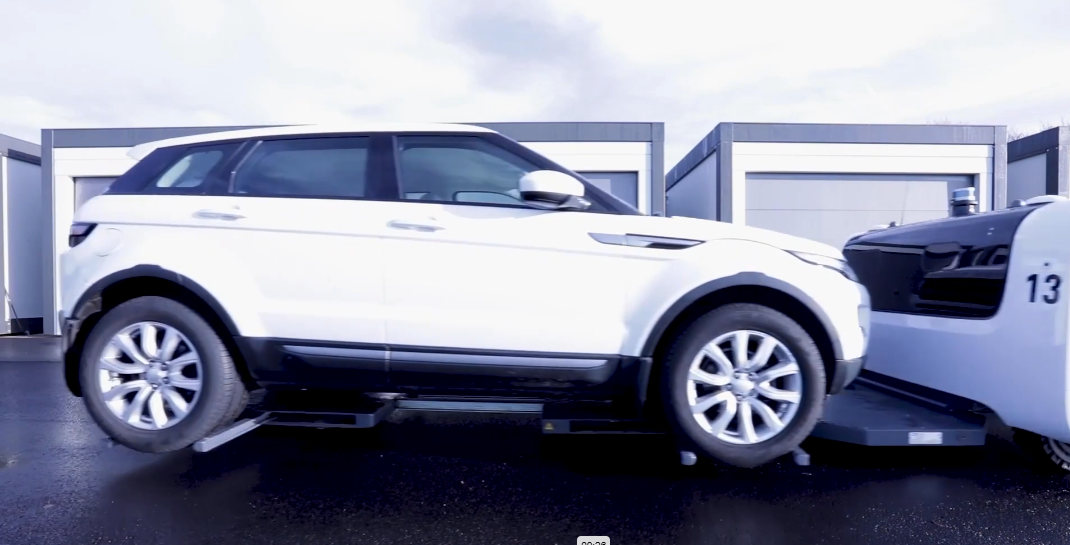
London Gatwick will open the UK’s first robotic valet car park in August, using autonomous vehicles supplied by French firm Stanley Robotics, the airport said.
The commercial driver is land, not passenger comfort. Robotic systems park cars without door clearance or pedestrian aisles, raising the number of vehicles that fit on a given area of tarmac. Stanley Robotics chief executive Clément Boussard said the deployment addresses Gatwick’s “critical parking capacity challenges” as the airport prepares for growth. Car parking is among the highest-margin ancillary lines an airport controls, and yield per square metre is the number that matters.
Users book in advance, drive into a private drop-off cabin near the South Terminal, switch off the engine and confirm the booking on a screen. They then walk to the terminal, which Gatwick puts at six minutes, or take a free shuttle bus, put at seven to 15 minutes.
A robot then slides beneath the vehicle, lifts it by the tyres and moves it to a secure parking area. Drivers keep their keys throughout, which distinguishes the system from conventional valet parking. Return flight details are captured at booking, and the system tracks the inbound arrival and returns the car to a collection cabin.
The launch service carries constraints. Booking must be made in advance, with no drive-up option. Vehicles must be left for a minimum of five days, and both drop-off and collection are restricted to weekdays. Gatwick said the limits would be adjusted and eased as the operation scales.
Vehicle specification also limits the addressable market. The system takes cars up to 2.6 tonnes in weight with a maximum wheelbase of 3.3 metres, which the airport puts at roughly 95% of models on the road.
Stanley Robotics opened its first outdoor robotic car park to the public at Lyon Saint-Exupéry in 2018, and the Lyon service remains in operation.
Bookings for the Gatwick service are open, with the first customer journeys due in August.
Why it matters for the trade
The restrictions decide who can sell this. A five-day minimum with weekday-only drop-off and collection rules out short city breaks and the weekend-departure leisure product that makes up much of the UK outbound calendar. What it fits is package holidays of a week or more and longer-haul departures, where the parking spell is long enough to justify the premium and the outbound day is flexible.
Agents adding it as an ancillary should check the vehicle spec before quoting. The 2.6 tonne ceiling is tighter than it sounds. Several large electric SUVs sit at or above it once loaded, and that segment is over-represented among the affluent drive-to-airport customers most likely to buy a premium parking product. A declined vehicle at the cabin is a missed flight, not an inconvenience.
The liability position is worth understanding before you sell it. Passengers keep their keys and the car sits in a sealed automated zone with no human handover. That removes most valet failure modes but changes where responsibility sits in a damage claim. Ask for the terms in writing before bundling it into a package.
For airports outside western Europe, this is the case study to watch. The proposition is capacity from existing land, which is the constraint facing Gulf, South East Asian and Latin American airports with rising car ownership and no room to expand surface parking. Lyon has run the technology since 2018, so the operational risk is largely retired. What has not been publicly demonstrated at scale is the payback period, and that is the figure emerging-market operators will need before committing.