
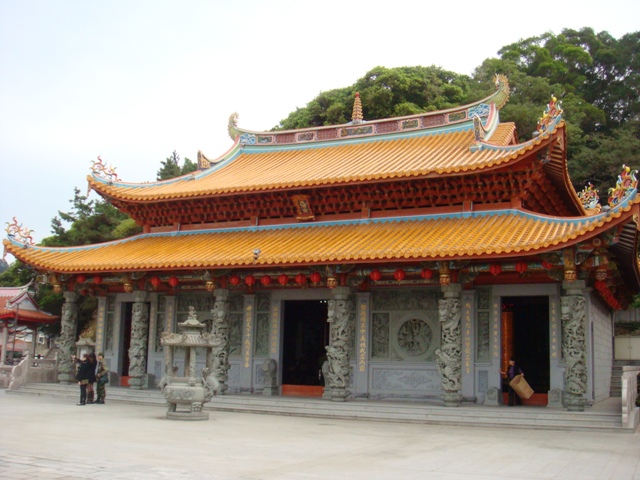
Out in the Taiwan Strait, closer to the coast of China’s Fujian province than to Taiwan itself, the Matsu Islands feel like a place history forgot to put back together. Granite cliffs fall into deep blue water, fishing villages cling to steep hillsides and narrow lanes lead to stone houses, temples and tunnels carved into solid rock.
On Nangan, the main and most populous island, on Beigan, a short boat ride away, and on Dongyin, two hours north by ferry, military bunkers sit beside old settlements, while fishing boats still work waters that have supported these island communities for centuries.
Matsu is not simply a smaller version of Taiwan. Administratively, the archipelago belongs to Taiwan’s Lienchiang County. Geographically and culturally, however, it is part of the world of eastern Fujian on the Asian mainland.
The islands lie about 15 km from the mouth of the Min River in China and more than 200 km from Keelung, on the northeastern tip of Taiwan’s main island. The principal islands are Nangan, Beigan, Dongyin and the Juguang pair of Dongju and Xiju, surrounded by smaller islands, islets and reefs.
Getting there
The journey is part of the experience. From Keelung, the New Taima and Taima Star ferries make the overnight crossing to Nangan or Dongyin, taking roughly eight to 10 hours depending on the route.
It is an old-fashioned way to arrive: leave Taiwan in the evening and wake to granite islands rising from the sea. Flights from Taipei’s Songshan Airport take less than an hour to Nangan, with some services also flying to Beigan, making air travel the obvious choice for a shorter visit. Dongyin has no airport, only a small heliport used by the military and for medical emergencies.
Nangan
Nangan is the largest and most developed of the islands and the natural base for exploring the rest of Matsu. Its villages, temples, coastline and extensive underground military works, now open to the public, give a concentrated introduction to the archipelago. The Beihai Tunnel, a huge passage blasted through solid granite by soldiers in the decades after the Second World War, is one of the most striking reminders of the islands’ military past.
Elsewhere, old settlements such as Jinsha keep the character of fishing communities that declined as fish stocks dwindled and residents moved away.
Beigan
A short crossing of the channel separating Nangan and Beigan leads to perhaps the most photogenic traditional architecture on the islands. Qinbi is a hillside village of stone houses and narrow lanes, built between mountain and sea.
Beigan’s villages, beaches and viewpoints reward slow exploration, while the long-abandoned and converted military positions dotting its coast offer a counterpoint to the traditional architecture.
Ferries between Nangan and Beigan run regularly and the crossing takes about 15 minutes, although schedules change with the season and the weather. Typhoons are frequent visitors in the summer months.
Dongyin
Further north, Dongyin feels, and is, more remote still. The northernmost of the principal Matsu islands and the northernmost point of Taiwanese-administered territory, it has some of the archipelago’s most dramatic cliffs, sea passages and military landscapes. Dongyong Lighthouse, Andong Tunnel and the precipitous coastal scenery are among its highlights. Like Nangan, the island can be reached directly from Keelung by overnight ferry, or from Nangan’s main port by inter-island ferry.
A language of its own
Language is one of the clearest reminders that Matsu is culturally distinct from Taiwan’s main island. Mandarin is widely understood and is the practical language for visitors, but the traditional local language is a form of Eastern Min, part of the Fuzhou language family of southeastern China. It is a separate Sinitic language, distinct from Mandarin or any Taiwanese accent, and decades of separation from Fujian have given Matsu speech its own features and vocabulary.
Mandarin increasingly dominates among younger generations, although efforts are under way to preserve and teach the Matsu language, one of Taiwan’s almost 20 recognised national languages.
From fishing grounds to frontline
For centuries, life on the Matsu Islands was shaped by the sea, and it still is. The islands offered little land for farming and few resources beyond what could be taken from the surrounding waters. Fishing, salt and maritime trade sustained the settlements, while contact with coastal Fujian brought people, language, architecture and religious traditions.
That maritime existence changed dramatically after 1949, when the islands became a frontline position in the confrontation between the Republic of China (Taiwan) and the People’s Republic of China. Military installations, tunnel networks, gun positions and fortified settlements spread across the islands, and civilian life was heavily restricted. Large areas remain reserved for military use.
Matsu stayed under battlefield administration until November 7, 1992, and restrictions on visitors were eased in the years that followed. Tourism followed, revealing a landscape in which Cold War remnants sit close to much older layers of island life.
Matsu today is neither a conventional beach resort nor merely a military-history destination. It offers a compact encounter with eastern Fujian culture, maritime Taiwan and Cold War history in a rugged island setting.
Getting around
Scooters are the most convenient way to explore Nangan and Beigan and are easy to rent, while taxis and buses offer alternatives. Ferries link the principal islands, but weather matters: strong winds, rough seas and fog often delay or cancel sailings.
Come for the granite coastline, stay for the stone villages, temples, food and military remnants. Whatever you do, allow time. Matsu rewards travellers who slow down.