
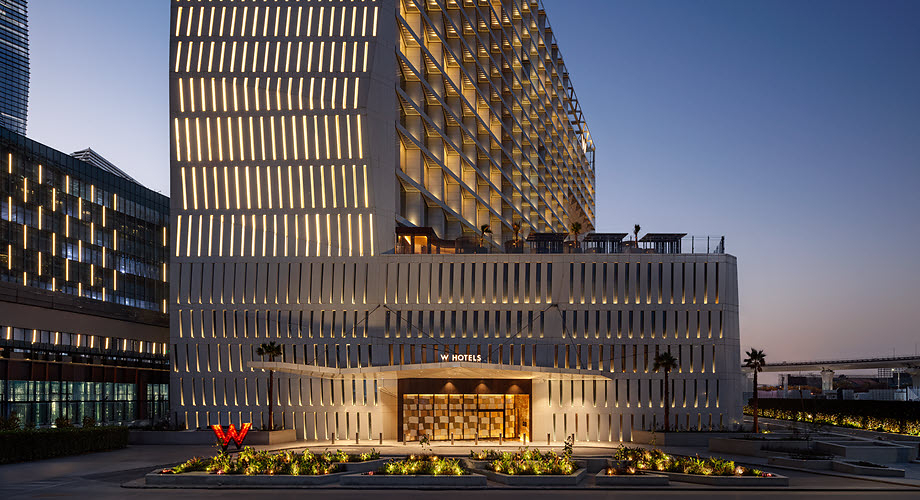
W Hotels has opened W Riyadh – KAFD, the brand’s first property in Saudi Arabia, placing Marriott International’s lifestyle luxury flag in the King Abdullah Financial District.
The 210-room hotel gives Marriott a lifestyle entry point in a market where the group already runs a substantial luxury footprint, and it lands in KAFD rather than the Diplomatic Quarter or Olaya, tying the opening to the district’s build-out as Riyadh’s business and leisure core. Saudi Arabia’s hotel pipeline remains one of the largest in the world, and brand debuts of this type are increasingly the mechanism by which operators stake ground ahead of the 2030 targets.
“The opening of W Riyadh – KAFD is a significant moment for the brand as it enters Saudi Arabia and reinforces our commitment to redefining luxury lifestyle hospitality across the Middle East,” said Helen Leighton, vice president, luxury brands, EMEA. “W Hotels has always been rooted in creativity and culture, and W Riyadh – KAFD is an expression of the brand’s design ethos, anticipatory service evolution, and immersive programming.”
The property holds 210 guestrooms, including 17 suites, two penthouse suites and the W Penthouse, which runs to 390 square metres with two bedrooms, separate living and dining areas, a kitchenette, an office and a gym with steam and sauna facilities. Penthouse suites carry floor-to-ceiling windows over downtown Riyadh.
Interiors are by LW Design, drawing on Najdi textiles and art, with stone and veined marble referencing desert and mountain landscapes, and geometric textures informed by Al Sadu weaving. A six-metre tapestry by Saudi artist Abdulnasser Gharem anchors the lobby, and Gharem also produced English and Arabic typography wall art in the guestrooms. The W Lounge uses circular banquettes and sunken tables informed by Bedouin firepit arrangements
Sira serves a Latin American-inspired menu from an open kitchen with open-fire cooking and a central bar serving crafted mocktails. Beni is an all-day coffee house with specialty coffee and artisanal ice cream. WET Deck is the outdoor pool setting with Mediterranean-inspired food and private cabanas. Sahari, an outdoor lounge built for scheduled performances, opens later this year.
The hotel carries 15 flexible meeting rooms and a ballroom, alongside the brand’s AWAY Spa and FIT fitness studio.
The location choice is the story. KAFD is a financial district, which means the base demand is corporate and the rate is underwritten by weekday business travel. Putting a lifestyle brand there rather than a conventional corporate flag is a bet that Riyadh’s business traveller now wants the W product, and that the district itself can generate weekend leisure and local F&B footfall to fill the trough. Fifteen meeting rooms and a ballroom tell you Marriott is not relying on lifestyle positioning alone to fill the asset.
For MICE buyers, this adds a lifestyle option to a Riyadh meetings inventory that has been dominated by traditional luxury and upper-upscale boxes. Agencies placing incentive groups in Saudi Arabia have had limited scope to differentiate on property character, and a W with a ballroom widens that.
The F&B build is aimed squarely at local spend. Four venues, including one that opens only later this year, is a heavy programme for a 210-room hotel, and the ratio signals that the restaurants are expected to trade on Riyadh residents rather than house guests. That is the W playbook, and it works where the surrounding district has resident affluence. It also matters for the alcohol-free proposition: the mocktail bar at Sira and the coffee house at Beni are the social anchors that in other W markets would be a bar programme, and operators watching how that performs will read it as a test case for lifestyle hospitality economics in the Kingdom.
The design commissioning is worth noting for the wider trade. Marriott has put a named Saudi artist at the centre of the public spaces rather than importing a generic regional aesthetic, which fits the direction of travel for Saudi tourism authorities pressing for local cultural content in new-build hospitality. Expect that to become a condition of approval rather than a marketing choice.
